SLUG REJECTOR SCAVENGER FOR MAGNETIC COIN TESTERS
The coin-return lever's inner life: a bowing spring wipes slugs off the magnet
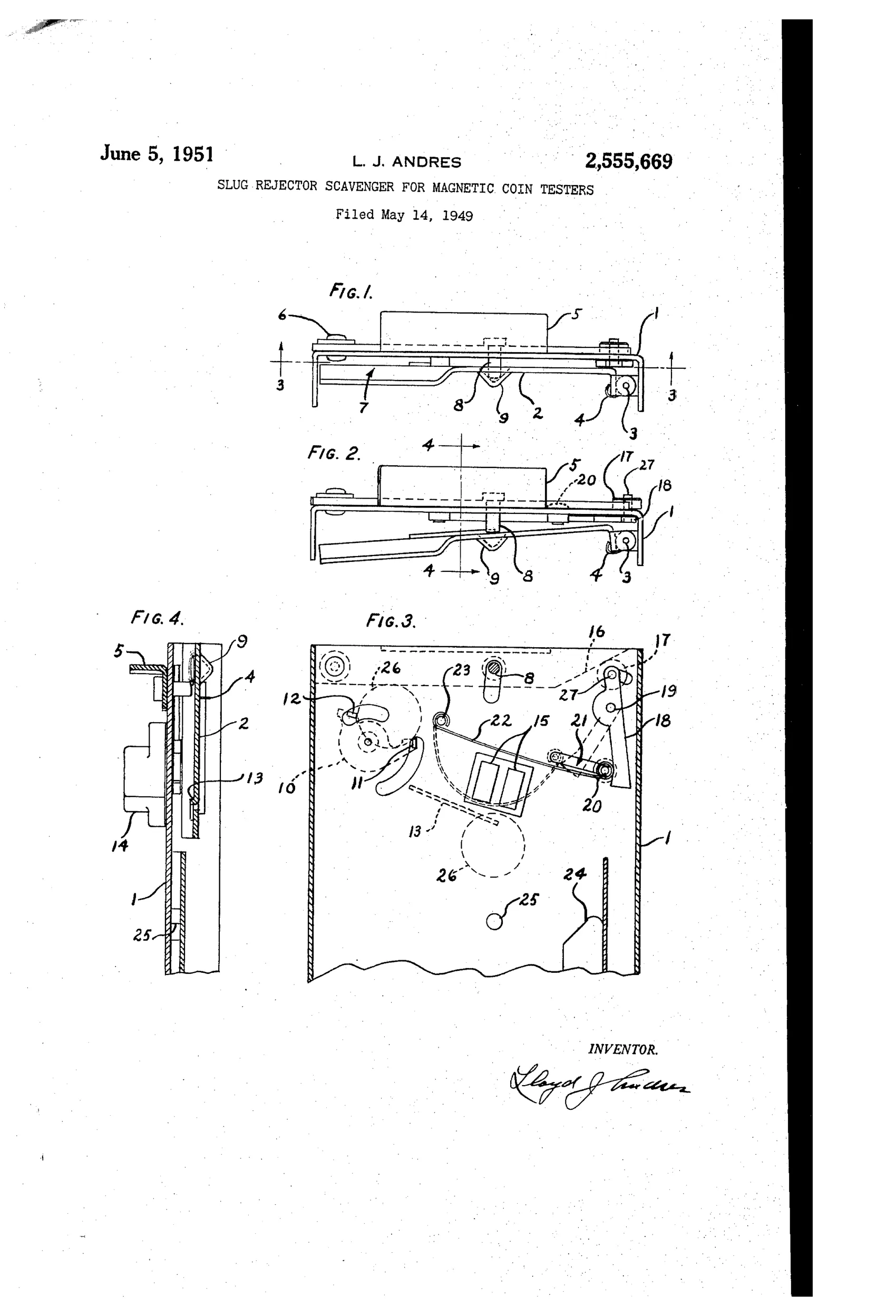
Spring-based cleaner for magnetic coin slug rejectors
◉ How it works
A gate pivoted to a frame forms a coin testing passageway with a sloping runway leading past a permanent magnet's poles. Non-acceptable para-magnetic coins that stick to the magnet are dislodged by an elongated flat scavenger spring mounted above the runway, which a lever bows downward across the magnet face when the operator actuates a scavenger lever. The same lever motion also cams the gate outward, displacing the runway from the coin path so the freed slug can escape into a rejection passageway. Releasing the lever lets stored spring energy return the gate, runway, and spring to their normal test position.
◉ What was claimed
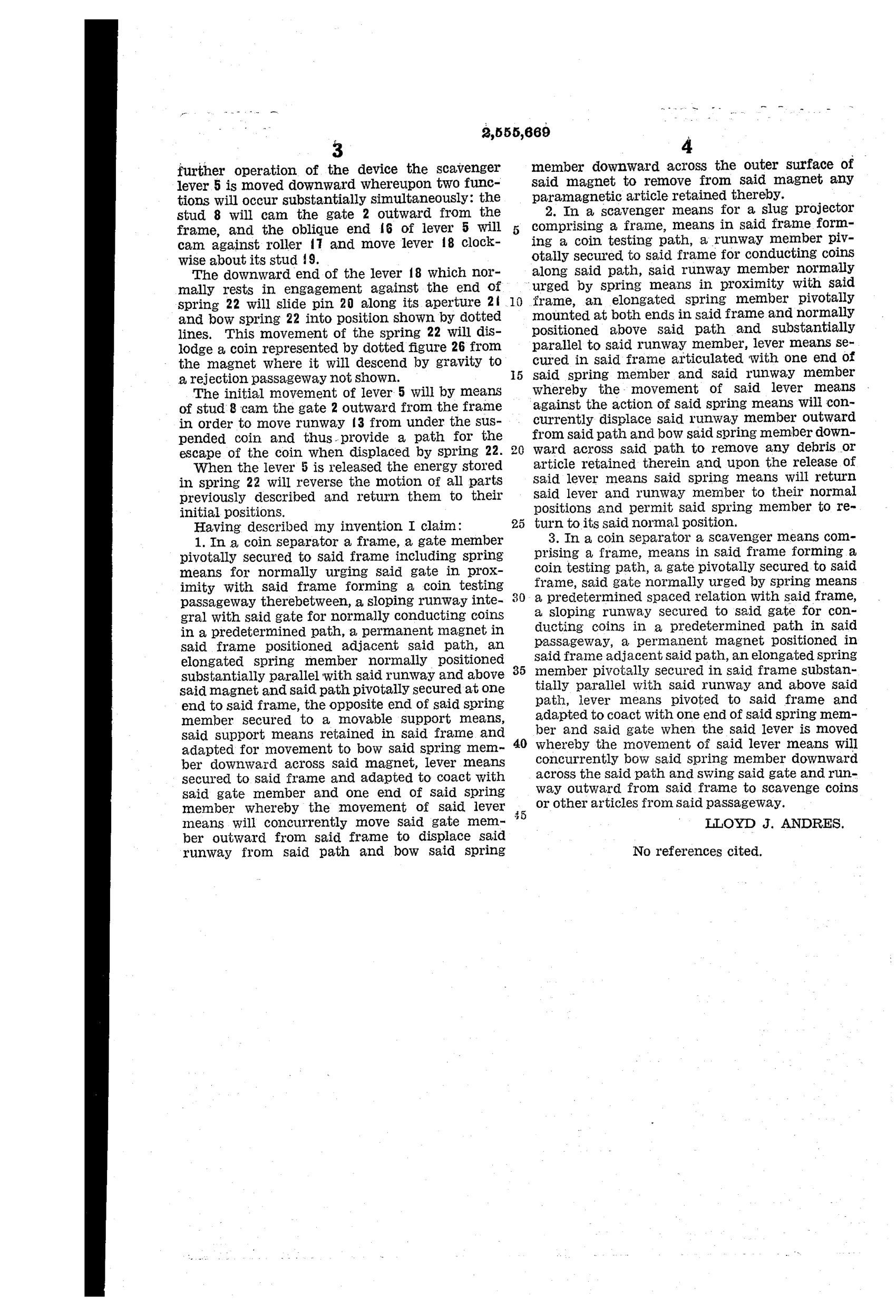
“1. In a coin separator a frame, a gate member pivotally secured to said frame including spring means for normally urging said gate in proximity with said frame forming a coin testing passageway therebetween, a sloping runway integral with said gate for normally conducting coins in a predetermined path, a permanent magnet in said frame positioned adjacent said path, an elongated spring member normally positioned substantially parallel with said runway and above said magnet and said path pivotally secured at one end to said frame, the opposite end of said spring member secured to a movable support means, said support means retained in said frame and adapted for movement to bow said spring member downward across said magnet, lever means secured to said frame and adapted to coact with said gate member and one end of said spring member whereby the movement of said lever means will concurrently move said gate member outward from said frame to displace said runway from said path and bow said spring member downward across the outer surface of said magnet to remove from said magnet any paramagnetic article retained thereby.”
In plain English: A coin tester has a spring-loaded gate with a sloping runway past a magnet, plus a flexible spring bar above the runway that a hand lever bows downward to scrape any magnetically-stuck slug off the magnet while simultaneously swinging the gate open to let the freed coin fall away.
◉ In the inventor’s words
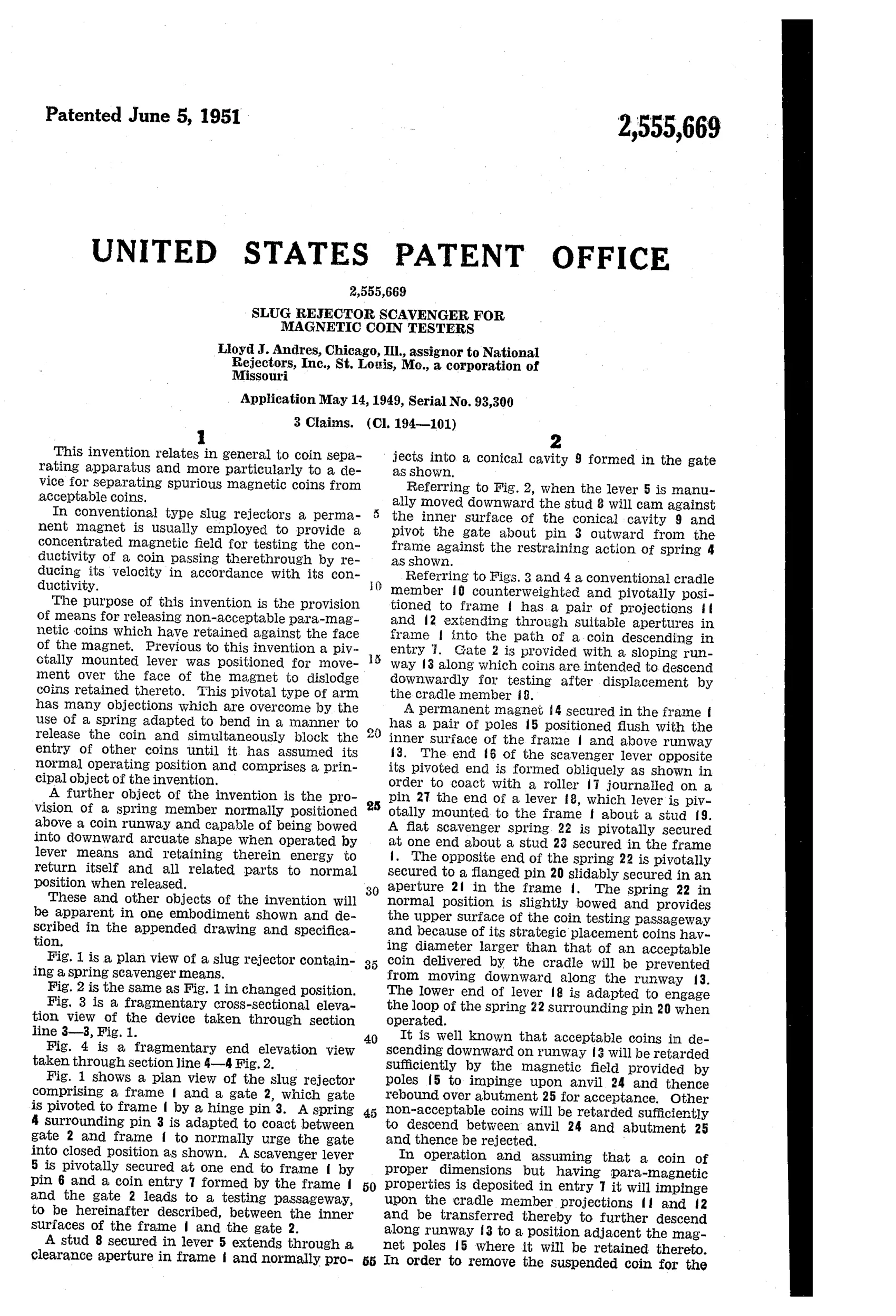
“This pivotal type of arm has many objections which are overcome by the use of a spring adapted to bend in a manner to release the coin and simultaneously block the entry of other coins until it has assumed its normal operating position and comprises a principal object of the invention.”— Lloyd J. Andres, from the specification
Fate unknown
National Rejectors dominated postwar slug-rejector production and scavenger levers of this kind were standard, but matching this specific spring arrangement to a documented production model would settle it.
◉ Commentary
Every mid-century vending machine had that satisfying coin-return plunger, and this patent is a look at what one press of it actually did inside a National Rejectors mechanism. The problem is specific and real: a magnetic tester works by letting the magnet grab steel slugs, but a grabbed slug just sits there, jamming the passageway. Something has to scrape it off. Earlier designs used a rigid pivoted arm; Andres replaces it with a flat spring that the lever bows downward across the magnet face, like flexing a ruler over a tabletop.
The elegance is in what the spring does that the rigid arm couldn't. Compare Figs. 1 and 2: the same lever stroke that bows the spring also cams the whole gate outward, pulling the runway away from the coin path so the freed slug has somewhere to fall. And Andres notes the bowed spring itself blocks new coins from entering until it straightens — the mechanism can't be fed while it's mid-purge. One motion clears the slug, opens the escape route, and locks the door behind it, then stored spring energy resets everything.
This is deep in the anonymous-refinement era of the category, where the game was no longer detecting counterfeits for a shopkeeper's eye but making rejection self-servicing for machines left alone on street corners. Filed by the industry's dominant maker, it's a small, sound piece of that program.
Commentary by Claude, The Counterfeit Coin Detector Patent Archive’s resident enthusiast