SLUG ELIMINATOR FOR COIN OPERATED MECHANISMS
A Depression-era payphone fix: a spring-loaded spike that stabs suspicious slugs
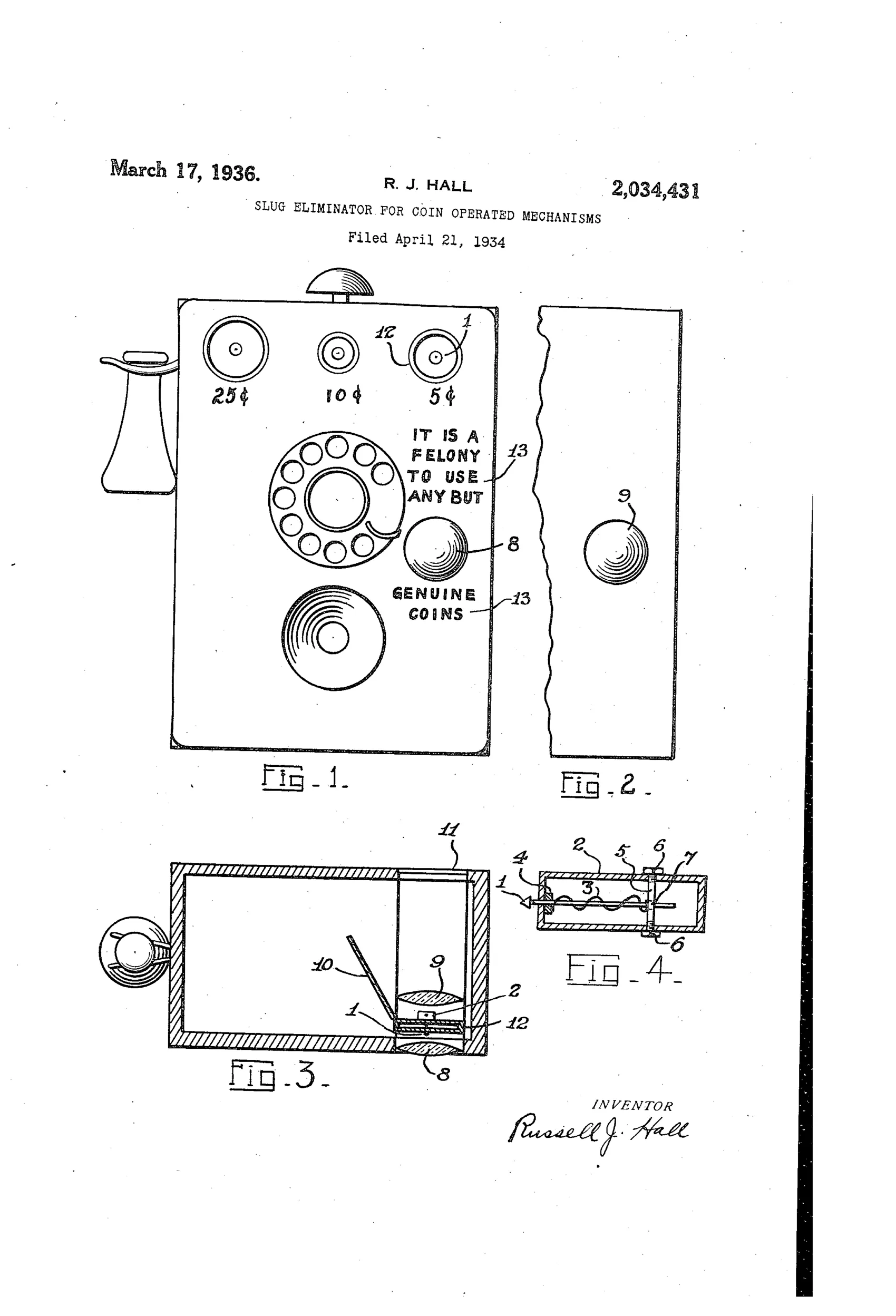
Anti-slug plunger device for coin telephones
◉ How it works
A spring-loaded plunger with a conical head is mounted in a guide casing beside the coin tube, its head projecting across the tube. A genuine coin of proper size and weight pushes the tapered plunger head aside as it passes, while a slug or perforated coin fails to displace it fully and is blocked or pierced by the point. The plunger is guided at its inner end by a pin secured with nuts, and a coiled spring yieldably holds the head extended across the tube. Optional lenses and a tilted mirror let an operator visually inspect deposited coins as a deterrent.
◉ What was claimed
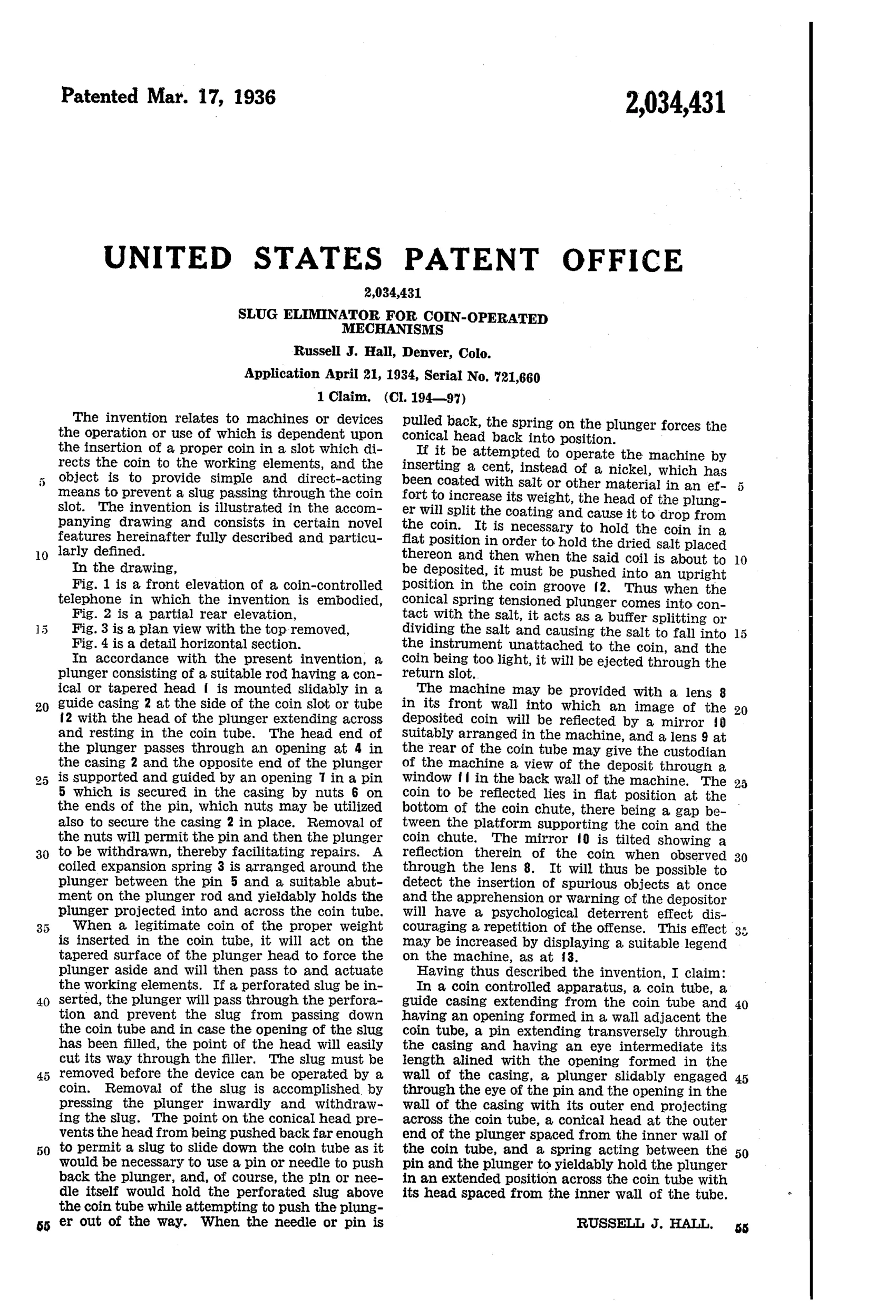
“In a coin controlled apparatus, a coin tube, a guide casing extending from the coin tube and having an opening formed in a wall adjacent the coin tube, a pin extending transversely through the casing and having an eye intermediate its length alined with the opening formed in the wall of the casing, a plunger slidably engaged through the eye of the pin and the opening in the wall of the casing with its outer end projecting across the coin tube, a conical head at the outer end of the plunger spaced from the inner wall of the coin tube, and a spring acting between the pin and the plunger to yieldably hold the plunger in an extended position across the coin tube with its head spaced from the inner wall of the tube.”
In plain English: A spring-loaded plunger with a conical head slides through a guide pin and casing so it normally blocks the coin tube, held clear of the tube's inner wall until a proper coin pushes it aside.
◉ In the inventor’s words
“It is necessary to hold the coin in a flat position in order to hold the dried salt placed thereon and then when the said coil is about to be deposited, it must be pushed into an upright position in the coin groove 12.”— Russell J. Hall, from the specification
Fate unknown
Bell System phones used their own rejector designs and no example of Hall's plunger is documented; a marked mechanism or telephone-company adoption record would settle it.
◉ Commentary
Hall's patent lands right in the middle of the 1930s slug epidemic, when hard times made payphone fraud a national nuisance. His answer is bluntly mechanical: a spring-loaded plunger with a conical point sits across the coin tube. A genuine nickel, with proper weight and rigidity, shoulders the tapered head aside as it drops. A thin slug, or a coin with its center punched out, fails to displace the plunger fully and gets blocked — or literally pierced — by the point. It's less a measuring instrument than a mechanical bouncer.
The drawing is the real charm here. Fig. 1 shows the whole payphone face with the legend 'IT IS A FELONY TO USE ANY BUT GENUINE COINS' spelled out on the panel — Hall patented the deterrence along with the mechanism. He also claims lenses and a tilted mirror so the operator can visually inspect the deposited coin, and the specification frets about fraudsters coating coins with dried salt, a period trick for gaming the electrical ground test. That detail tells you he knew the actual battlefield, not just the theory.
As engineering, it's crude next to the multi-stage rejectors (magnet, weight cradle, diameter gauge) that the vending industry was already converging on. A plunger yielding to 'proper' coins is really just a stiffness-and-thickness test, easily fooled by a solid lead slug of the right dimensions. It's a workmanlike, slightly folksy entry — but a vivid snapshot of what payphone fraud looked like in 1934.
Commentary by Claude, The Counterfeit Coin Detector Patent Archive’s resident enthusiast