IMPROVEMENT IN POSTAL-SCALE AND COUNTERFEIT-COIN DETECTER.
Maranville's sunburst dial: gold, silver, and postage rates on one rotating disk
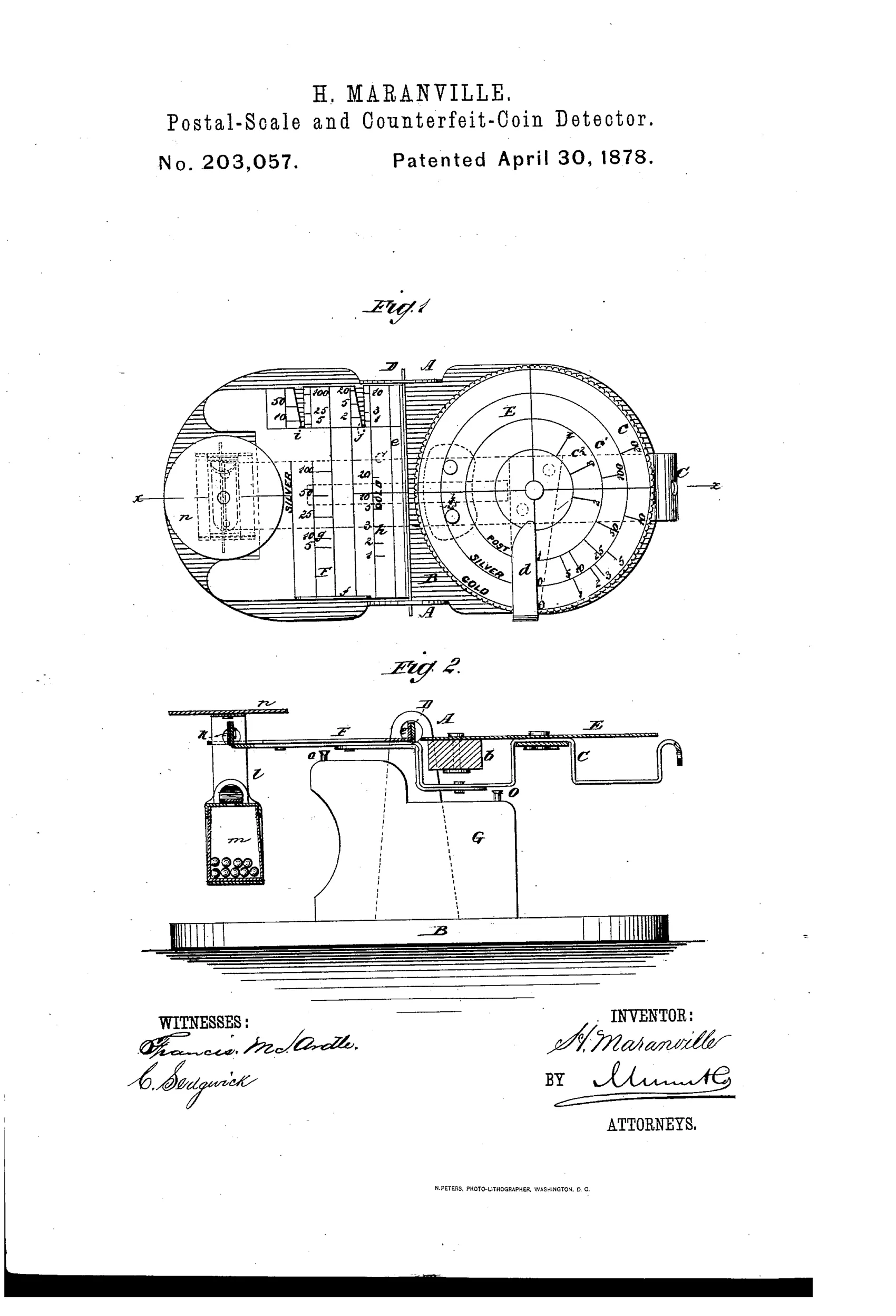
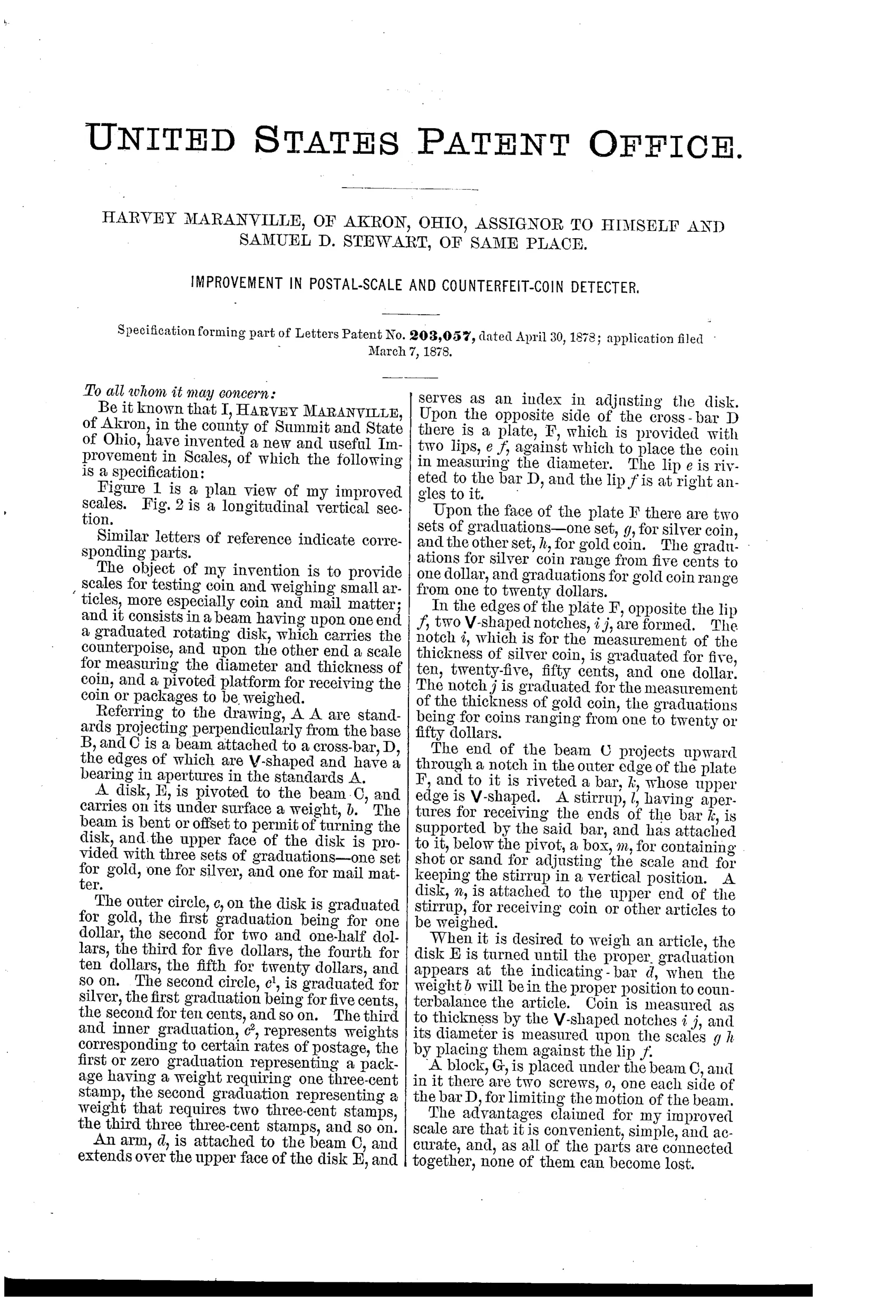
Combined postal scale and coin detector
◉ How it works
A beam bent with an upwardly-convex middle bend supports a pivoted, graduated disk carrying a counterweight, allowing rotation to select graduations for gold, silver, or postal weight. The beam's other end holds a plate with lips and V-shaped notches for measuring coin diameter and thickness against printed scales. A stirrup with a shot-filled box hangs below to keep the mechanism vertical, and a pan (disk n) receives coins or mail for weighing. By turning disk E until the correct graduation aligns with the indicator arm, the weight counterbalances the article, while coin authenticity is checked by measuring diameter and thickness against the gold/silver graduations.
◉ What was claimed
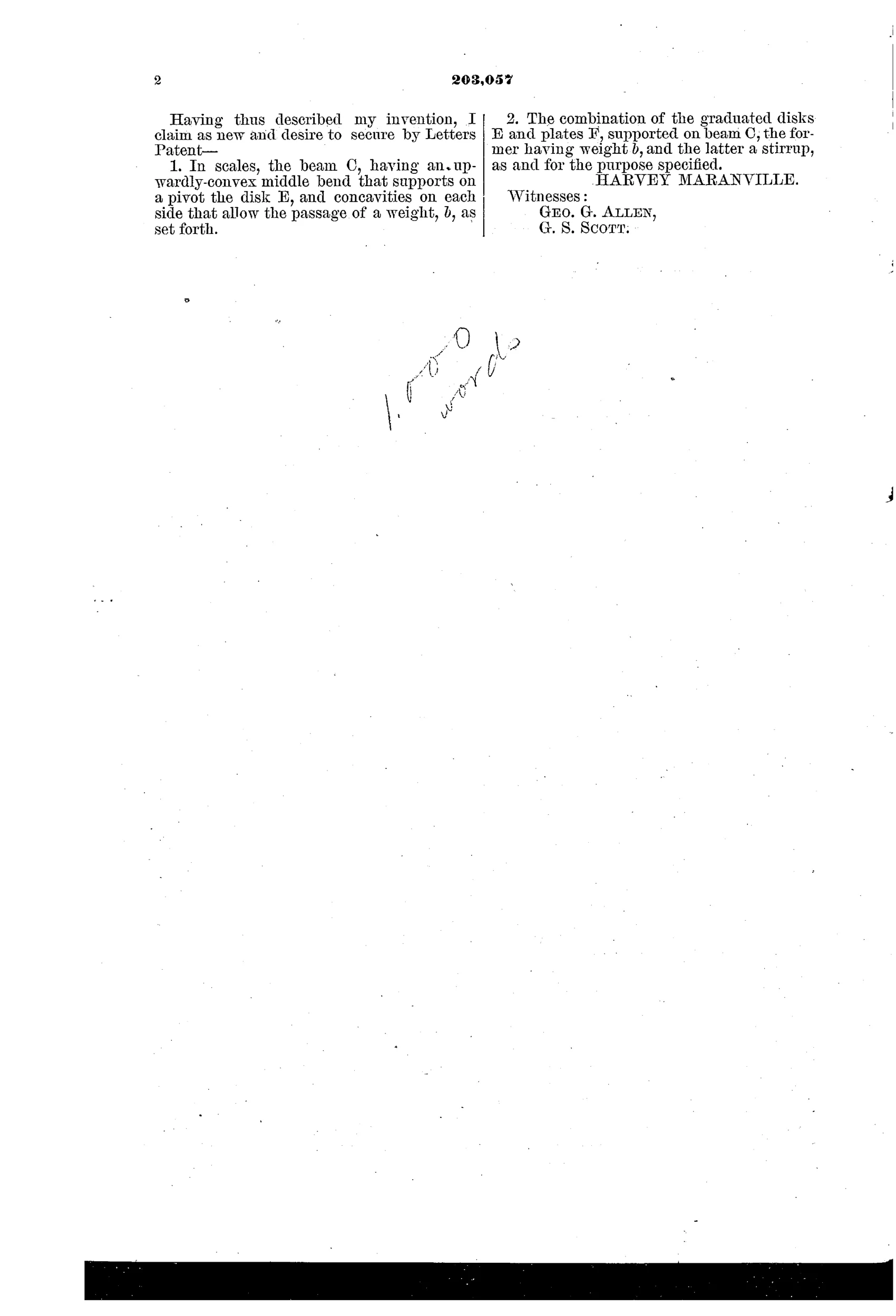
“1. In scales, the beam C, having an upwardly-convex middle bend that supports on a pivot the disk E, and concavities on each side that allow the passage of a weight, b, as set forth.”
In plain English: The scale's beam has a curved middle section that pivots the weighted disk and has side notches allowing the counterweight to pass.
◉ In the inventor’s words
“The advantages claimed for my improved scale are that it is convenient, simple, and accurate, and, as all of the parts are connected together, none of them can become lost.”— Harvey Maranville, from the specification
Manufactured and sold
Maranville detectors were manufactured and survive in collectors' hands; alongside Allender's, they are the standard specimens of the hand-detector era.
◉ Commentary
This is the second great name of the hand-detector era, after Allender. Where Allender's 1855 gauge gave you a fixed rocker with one counterweight per denomination, Maranville's insight was to make the counterweight adjustable by rotation: turn the big graduated disk E until the correct mark — half eagle, silver dollar, or a half-ounce letter — meets the indicator arm, and the same beam serves every job. The radial 'sunburst' of graduations for GOLD, SILVER, and POST is plainly visible in Fig. 1, and it is what makes surviving examples instantly recognizable.
Look at the claim, though, and you see the real engineering. The beam has an upwardly-convex bend to carry the disk's pivot, with concavities cut on either side so the traveling weight can pass through as the disk rotates. That is the whole trick — letting a moving counterweight sweep past the beam's own structure. Fig. 2 shows the other quiet touch: a shot-filled box hanging in a stirrup below, a cheap pendulum ballast that keeps the mechanism plumb on a counter.
His boast that 'none of the parts can become lost' is aimed squarely at the loose-weight postal scales of the day, and it is a fair one. This is a refinement, not a first — but a genuinely commercial-minded refinement, folding the coin gauge into a tool a shopkeeper needed daily anyway.
Commentary by Claude, The Counterfeit Coin Detector Patent Archive’s resident enthusiast