CHECK SELECTING APPARATUS
Two lever arms on one balance: momentum absorbed first, weight judged second
Coin/check weight-testing rejector for vending machines
◉ How it works
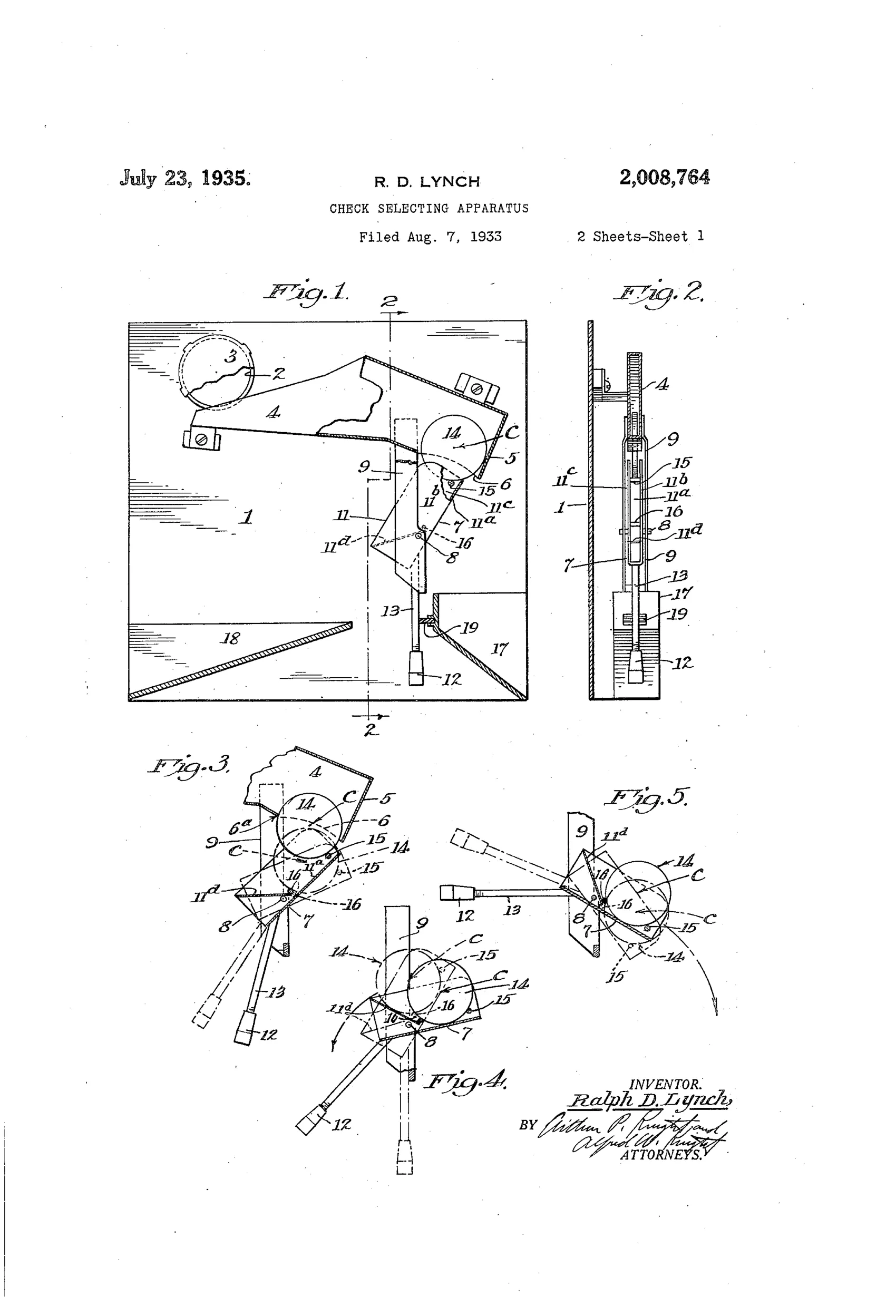
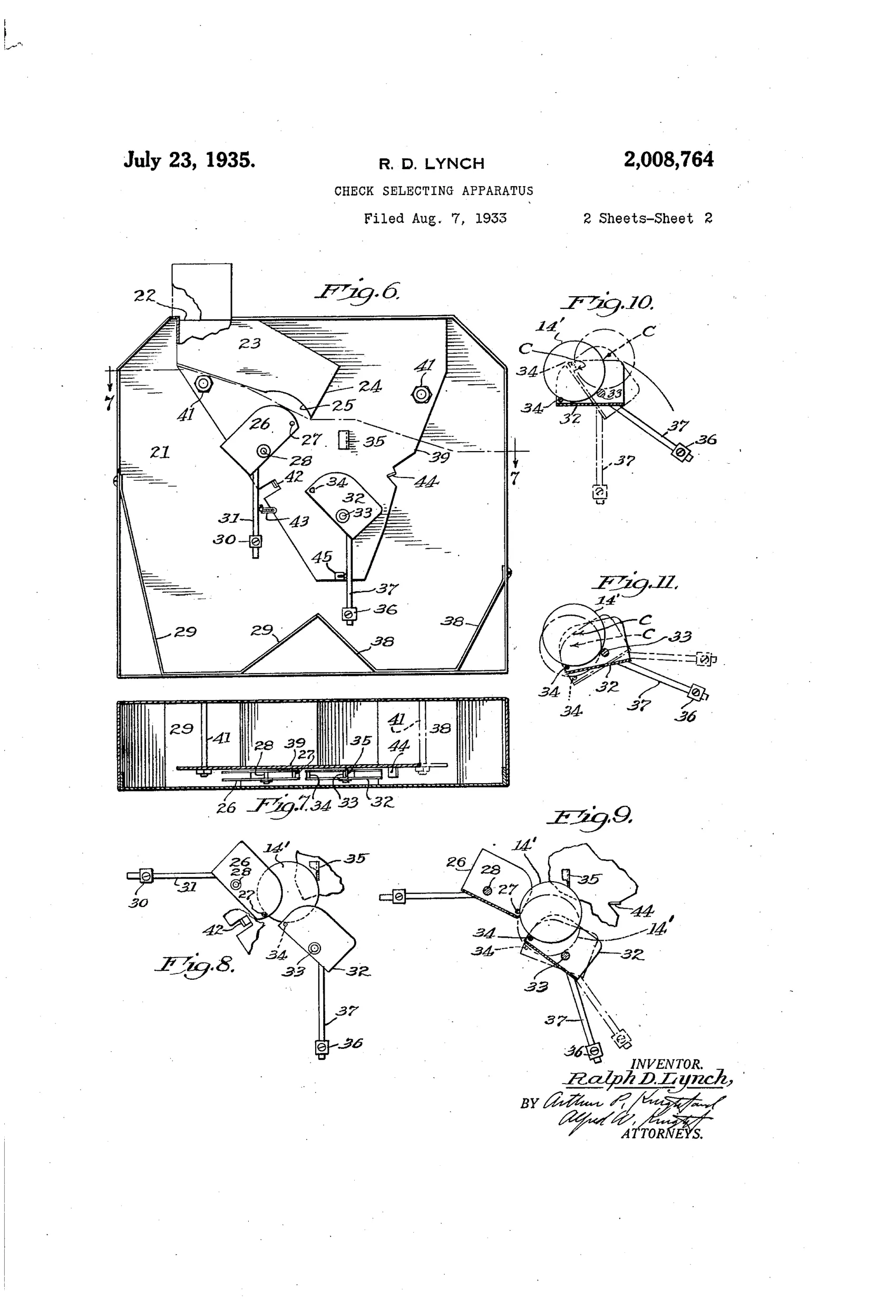
A downwardly inclined chute delivers a coin or check by gravity through an opening onto a pivoted balance member positioned to one side of the check's center of gravity. The check first strikes an outer support member, acting on a long lever arm to swing the balance into a check-receiving position, absorbing momentum. As the balance rotates further, the check settles onto a shorter inner lever arm close to the pivot axis, so its true weight now determines the tipping direction. If the check is at or above the legal weight it overbalances to one side and is delivered to the accepting chute; if underweight it tips the other way and is rejected, with a second balance optionally testing for overweight as well.
◉ What was claimed
“A check selecting device comprising: downwardly inclined chute means having a downwardly directed opening at the lower end thereof; a pivotally mounted balance member having a check-receiving portion positioned below said opening; weight means secured to said balance member and biasing said check-receiving portion to the position aforesaid; check-supporting means on said balance member in position to engage a check delivered downwardly through said opening before complete delivery of said check from said opening in such manner as to cause rotation of said balance member in one direction in response to the weight and momentum of said check acting on said balance member through a lever arm of constant length defined by the position of said supporting means relative to the axis of said balance member during passage of said check through said opening, and said check-supporting means being further positioned to receive said check after complete delivery thereof from said opening and position the same within said check-receiving portion in such position that the weight of said check acts upon said balance member on a lever arm of constant length and shorter than said first-mentioned lever arm.”
In plain English: A coin chute drops a check onto a pivoted balance arm that first catches it on a long lever arm to absorb momentum, then lets it settle onto a shorter lever arm where its actual weight tips the balance to accept or reject it.
◉ In the inventor’s words
“The term 'check', as used hereinafter will be understood to include any coin, check, or comparable article, consisting of metal or other material and capable of causing operation of such vending machines or other apparatus.”— Ralph D. Lynch, from the specification
Fate unknown
The half-interest assignment suggests commercial intent, but no vending mechanism is documented using this specific two-arm balance; a marked machine part would settle it.
◉ Commentary
The nuisance with weighing a falling coin is that it doesn't arrive gently — it arrives with momentum, and a simple balance can't tell a heavy coin from a light one hitting hard. Lynch's answer is quietly elegant: the coin first strikes a support far from the pivot, on a long lever arm, which swings the balance into a catching position and soaks up the impact. Only after the coin has settled does it come to rest on a short arm near the axis, where static weight — not velocity — decides which way the balance tips. Underweight slugs go one way, legal coins the other; a second balance in the modified version (Figs. 6-11) culls overweight cheats too, bracketing the coin from both sides.
The sequence in Figs. 3 through 5 is worth reading like a flip-book: the same pivoted member catching, cradling, and then discharging the check left or right. That's the whole trick — one moving part doing three jobs in order.
By 1933 this class is deep in the anonymous-chute era; hundreds of inventors were chasing the slug problem for vending machines, most with magnets and sizing gates. Lynch's contribution is a genuine refinement of the pure weight test, addressing its real weakness (dynamic loading) rather than papering over it. Whether any manufacturer bought it, the record doesn't say — half the patent was already assigned to a Venice, California backer, so someone believed in it.
Commentary by Claude, The Counterfeit Coin Detector Patent Archive’s resident enthusiast