COIN TESTING AND EJECTING MECHANISM FOR VENDING MACHINES
A spring lip flicks the failed slug sideways out of the machine
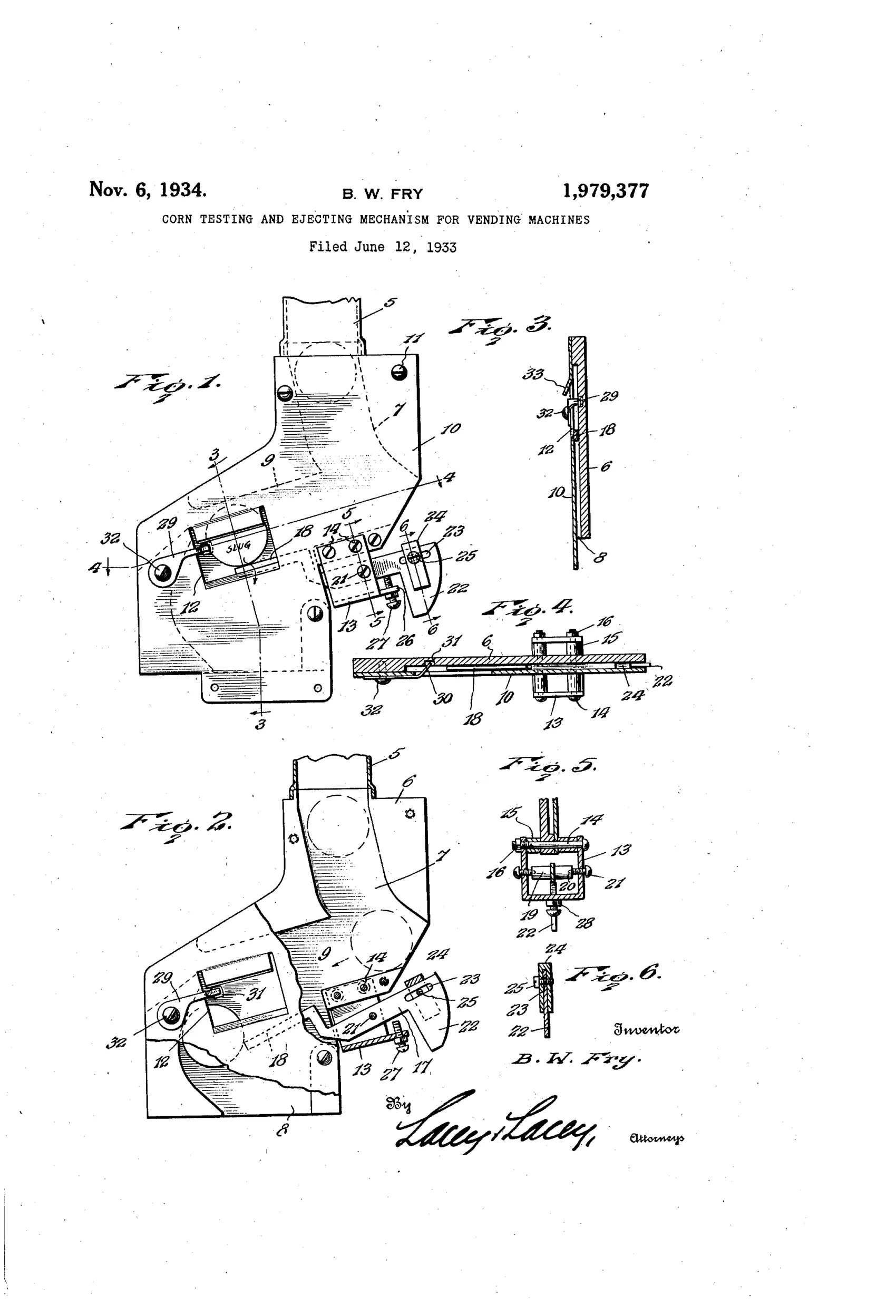
Automatic coin-weight tester and reject ejector for vending machines
◉ How it works
A weighing lever is pivoted on a bracket depending from the coin chute, with its reduced forward end normally resting just above and parallel to a discharge opening. A coin of standard or greater weight rolls over the lever's active end, tilting it downward so the coin passes through to the vending mechanism. A lighter coin or slug fails to depress the lever and instead rolls forward into a resilient spring lip; the impact deflects the coin laterally through a discharge opening in the face plate, ejecting it from the machine. An adjustable counterpoise on the lever's rear end and a threaded stop screw allow the balance point to be calibrated to a predetermined coin weight.
◉ What was claimed
“1. In a vending machine, the combination with a coin chute having a discharge opening communicating therewith, a weighing lever extending within the chute and actuated by a coin of predetermined weight to tilt said lever and permit passage of the coin, and a spring secured to the chute at one end of the discharge opening and having an inclined resilient lip projecting within said opening and across the coin passage and coacting with the lever for ejecting a coin of less weight from said chute.”
In plain English: A vending machine coin chute has a pivoting weighing lever that lets a coin of proper weight pass, while a spring-loaded angled lip ejects any lighter coin sideways out of the chute.
◉ In the inventor’s words
“A further object is to provide an automatic coin ejector embodying in its structure a weighing lever disposed in the path of the coins and responsive to a coin of a predetermined weight to tilt the lever and permit passage of the coin to the operating mechanism, and means coacting with the lever for ejecting a coin of less weight from the coin chute.”— Benjamin W. Fry, from the specification
Fate unknown
Like most in-chute testers, this design left no marked artifact; only a documented link to a St. Louis vending manufacturer's mechanism would settle whether it was produced.
◉ Commentary
By 1933 the weighing-lever coin test was old news — pivoted balances inside coin chutes had been standard vending-machine hardware for decades. What Fry adds is the second half of the transaction: what to do with the coin that fails. His answer is a resilient spring lip angled across the coin path at a discharge opening in the face plate. A full-weight coin depresses the lever and rolls past underneath; a light slug, riding high because the lever never tilted, runs into the inclined lip and gets deflected sideways clean out of the machine. The rejection is gravity plus a bent piece of spring steel — no latches, no reset motion, nothing for a jammed slug to hang on.
The drawing rewards a close look. Fig. 1 shows the slug (helpfully labeled 'SLUG') caught at the ejection point, while Fig. 2 shows the good coin passing — a before-and-after pair on one sheet. Note also the adjustable counterpoise and stop screw on the lever's rear end: the same casting could be calibrated to a nickel or a quarter at the workbench, which mattered to operators servicing mixed fleets.
This is a refinement, not a revolution — but it addresses the real Depression-era complaint, which wasn't detecting slugs so much as clearing them without a service call. Whether Fry's particular lip beat the dozens of competing reject chutes is another question; the class was crowded, and most of these designs vanished anonymously into vending hardware.
Commentary by Claude, The Counterfeit Coin Detector Patent Archive’s resident enthusiast