SHADED POLE ELECTRIC COIN SELECTOR
A shaded-pole motor field that spins the coin itself to judge its alloy
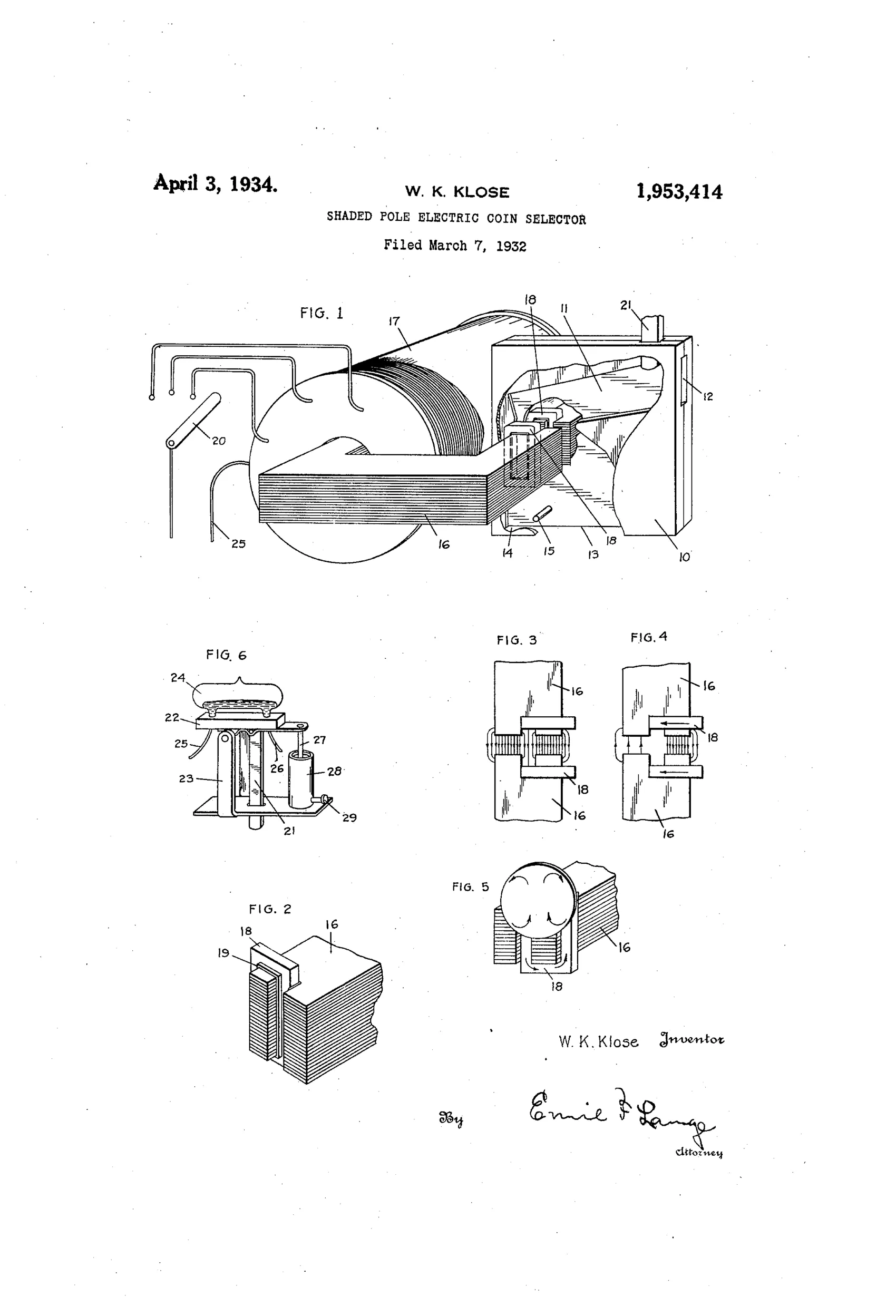
Electromagnetic coin selector using shaded-pole rotating field
◉ How it works
A coin rolls down an inclined dielectric chute and falls edgewise between the poles of an alternating-current electromagnet. Shading coils around portions of the pole pieces split the phase and create a rotating, oscillating magnetic field between the poles. This field induces eddy currents and magnetic poles in the falling coin depending on its metal's resistivity, causing coins of the desired alloy to be rotated and deflected rearward past an offset pin, while coins of other metals are pushed forward or suspended in the field. A mercury-switch timer with a piston-and-needle-valve dashpot automatically energizes the magnet when a coin is inserted and cuts the current off after an adjustable interval, releasing any suspended coins to fall through the discard outlet.
◉ What was claimed
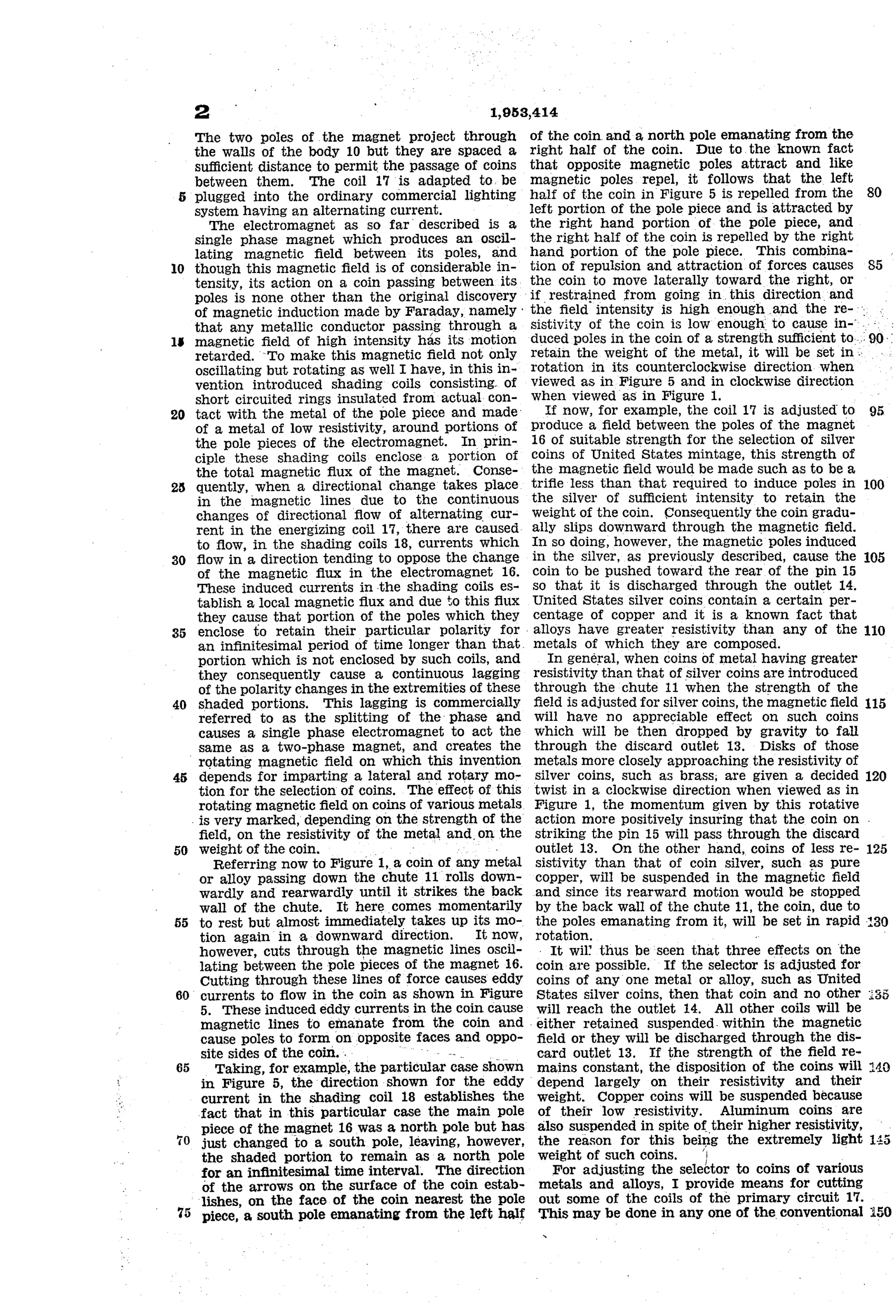
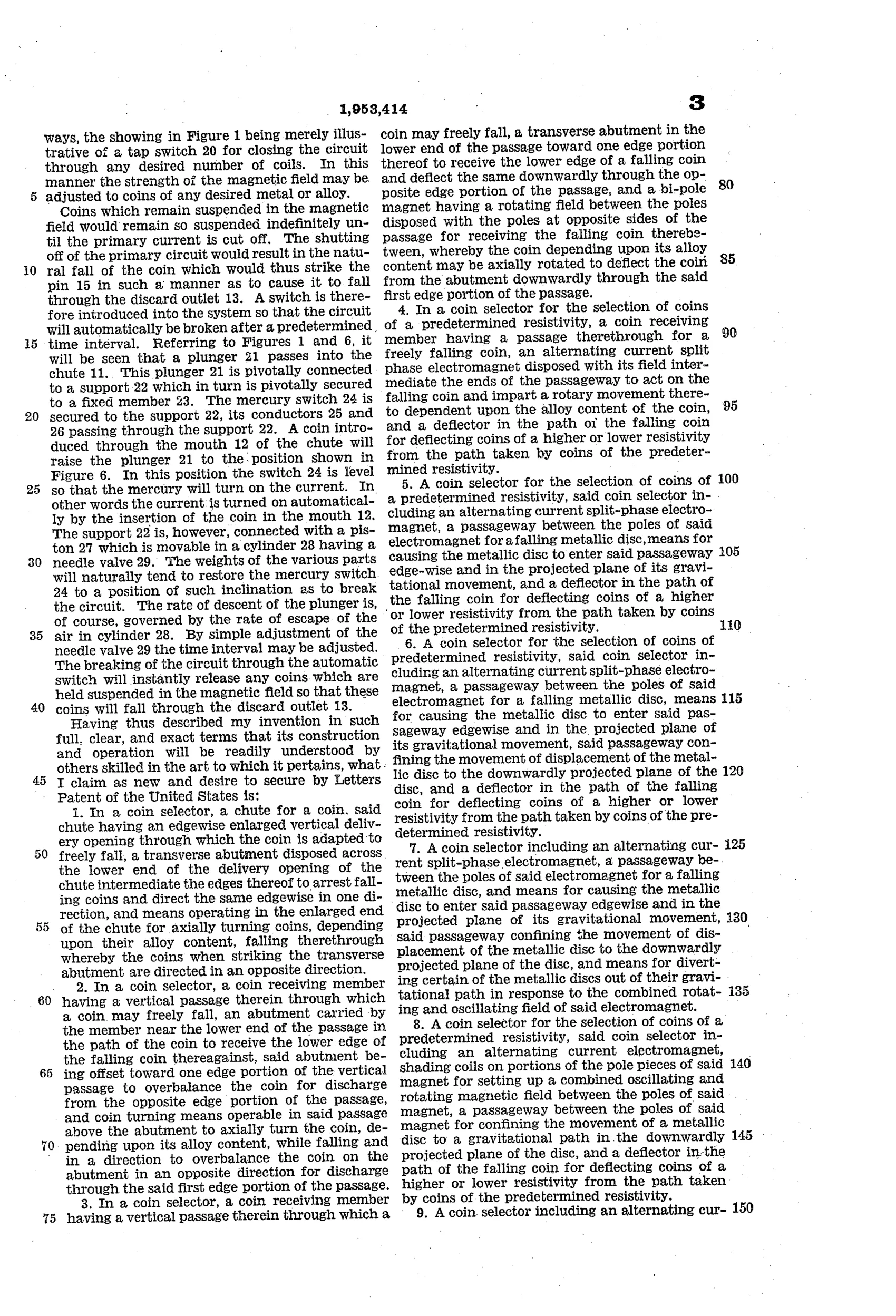
“1. In a coin selector, a chute for a coin, said chute having an edgewise enlarged vertical delivery opening through which the coin is adapted to freely fall, a transverse abutment disposed across the lower end of the delivery opening of the chute intermediate the edges thereof to arrest falling coins and direct the same edgewise in one direction, and means operating in the enlarged end of the chute for axially turning coins, depending upon their alloy content, falling therethrough whereby the coins when striking the transverse abutment are directed in an opposite direction.”
In plain English: The device has a chute where a falling coin is turned by a magnetic field depending on what metal it's made of, so that when it hits a small abutment inside the chute, coins of the right alloy get knocked one way and other coins go the opposite way.
◉ In the inventor’s words
“The problem of coin selection thus resolves itself into giving the desired coin a distinct rearward impulse so that when it strikes the pin 15, the preponderance of weight will be on the rear side of the pin 15, coins of other metals or alloys being not responsive to that impulse.”— Walter Karl Klose, from the specification
Fate unknown
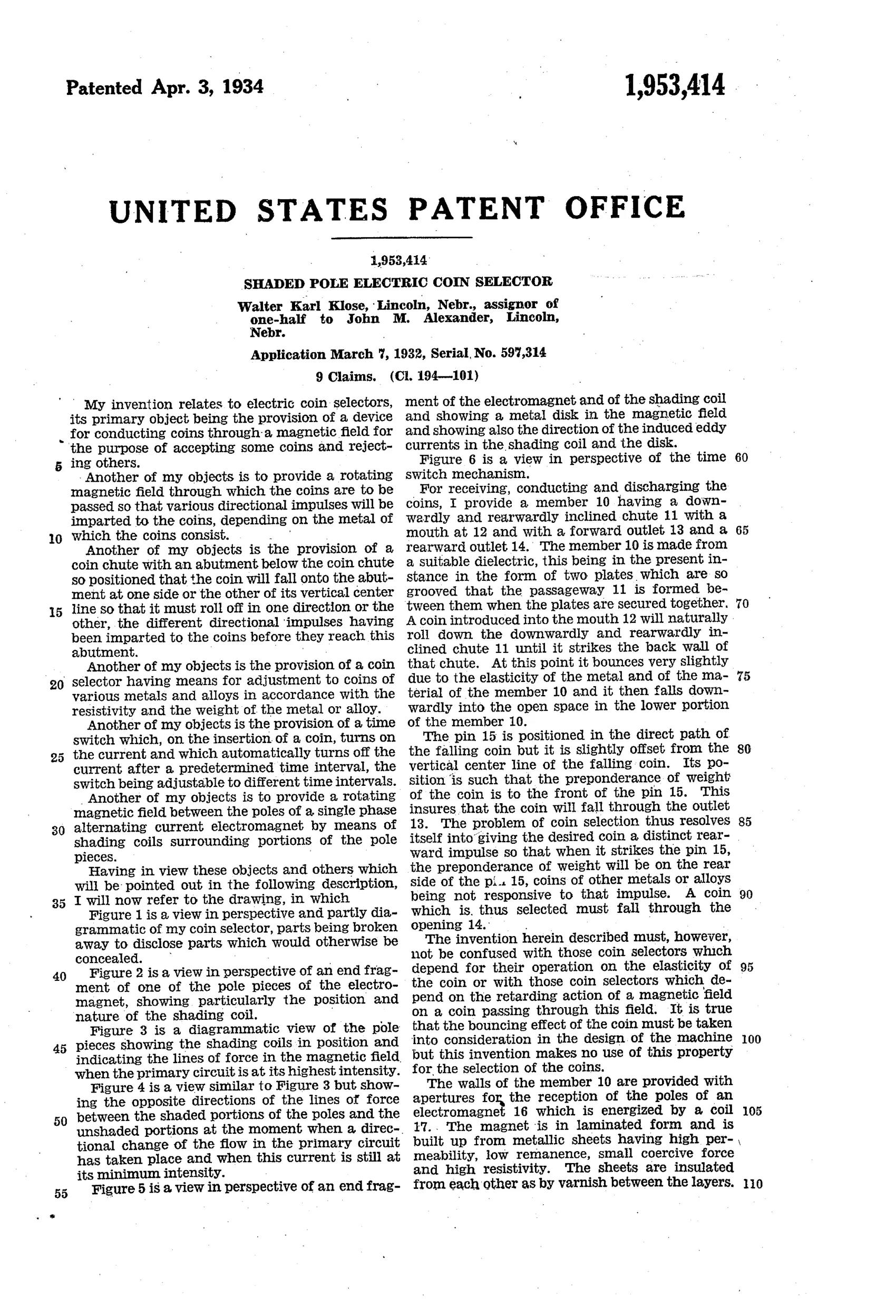
No commercial coin mechanism is documented using this specific shaded-pole design; a marked device or licensing record from assignee John M. Alexander would settle it.
◉ Commentary
Klose's idea is essentially a shaded-pole induction motor with the coin standing in for the rotor. Shading coils on the pole faces split the AC phase and produce a sweeping field; a falling coin picks up eddy currents, and the torque it receives depends on its resistivity. A genuine coin of the right alloy gets a rearward kick and lands behind a small pin; slugs of other metals get pushed the wrong way or — his best trick — simply hang suspended in the field until a mercury-switch timer cuts the power and drops them into the discard chute. Figures 3 through 5 are worth a look: they trace the reversing flux lines and eddy-current loops, showing Klose actually understood the physics rather than just waving a magnet at the problem.
This sits at an interesting hinge in the category. The magnet-in-chute testers of the 1900s-1920s were passive: a permanent magnet grabs or retards steel slugs. Klose goes active — energizing the field per coin and interrogating conductivity, which anticipates the eddy-current discrimination that modern coin validators still use. The dashpot-timed mercury switch (Fig. 6) is Depression-era pragmatism, saving current when the machine is idle.
Would it work? Probably, with fussy calibration — the deflection depends on coin diameter, drop speed, and line voltage as much as alloy. That fragility is likely why the elegant version stayed on paper while cruder gravity-and-magnet gates ruled the vending trade.
Commentary by Claude, The Counterfeit Coin Detector Patent Archive’s resident enthusiast