SPURIOUS COIN SEPARATOR
A weighted lever inside the payphone chute, tipping fakes out sideways
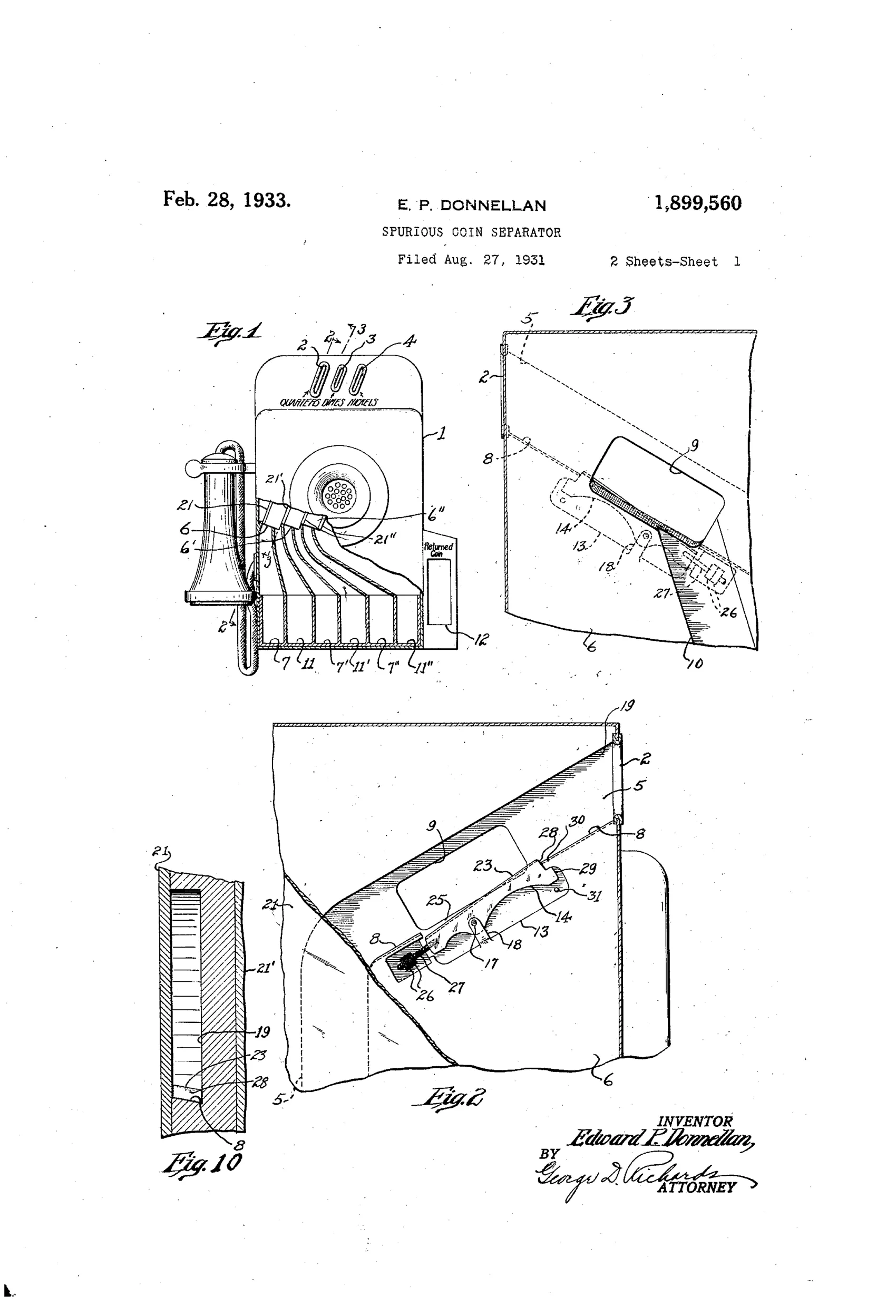
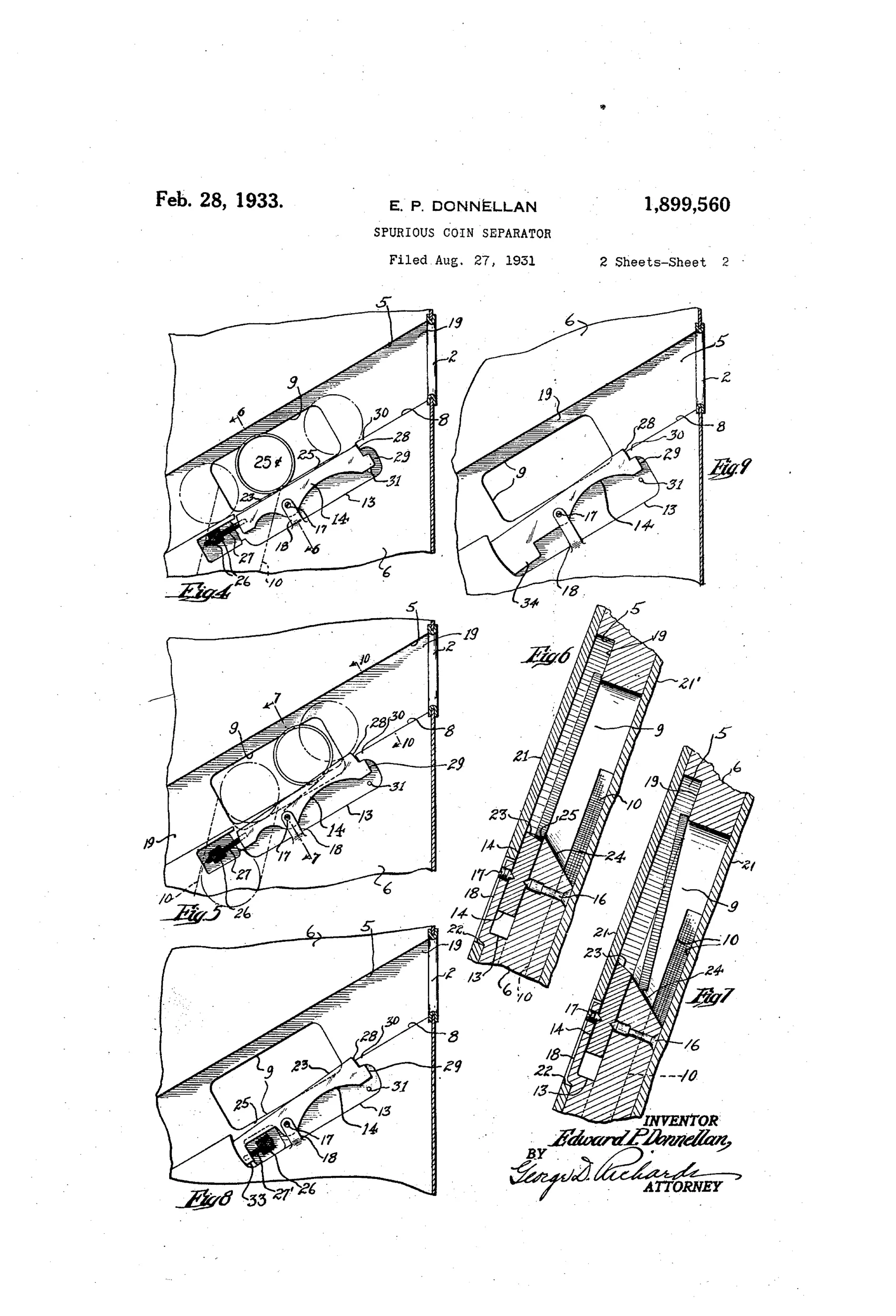
Coin separator that ejects lightweight counterfeit coins
◉ How it works
An inclined coin slot conducts coins downward while a pivoted, adjustably weighted lever projects up into the slot next to a discharge opening in the side wall. A genuine coin, being heavier, depresses the forward end of the lever, bringing its upper surface flush with the slot's lower wall so the coin rolls past the opening into the receiver. A lighter spurious coin fails to depress the lever, rides up over its shoulder, and is deflected sideways through the discharge opening into a reject chute, regardless of whether the fake coin is larger or smaller in diameter than the genuine one.
◉ What was claimed
“A spurious coin separator comprising, a member having a coin slot therein for conveying coins toward a receiving receptacle, said member having a spurious coin discharge opening communicating with said slot, said member being transversely inclined in a direction toward said opening, a lever pivotally carried by said member and positioned adjacent said slot and said discharge opening, said member having a passage between said lever and said slot through which said lever is arranged to project so as to extend into said slot above the adjacent margin of said discharge opening for the purpose of ejecting spurious coins through said discharge opening, said lever being depressible by a proper coin so as to be offset below the adjacent margin of said discharge opening.”
In plain English: A coin slot has a side discharge hole and a spring-like pivoting lever that a genuine coin pushes flat out of the way, while a lighter fake coin fails to push it down and gets knocked sideways out through the discharge hole.
◉ In the inventor’s words
“Heretofore, considerable loss has been sustained each year by owners and operators of slot machines, such as slot vending machines and telephone pay stations, and the like, owing to the use by irresponsible persons of counterfeit coins or other simulated coins.”— Edward P. Donnellan, from the specification
Fate unknown
Chute mechanisms like this were absorbed anonymously into coin equipment if adopted at all; only a marked mechanism or licensing record would settle it.
◉ Commentary
Donnellan's target is spelled out in his own preamble: telephone pay stations and vending machines bleeding revenue to slugs. His answer is a purely mechanical weight test performed in transit. A pivoted lever, ballasted with adjustable weights, pokes up into the inclined coin slot right beside a hole cut in the side wall. A genuine quarter has the heft to press the lever flush with the floor of the slot and rolls past the opening into the till. A light slug can't depress it, rides up over the lever's shoulder, and — because the whole slot is tilted sideways toward the opening — falls out into the reject chute.
The clever detail, easy to miss in Fig. 2, is that transverse tilt. Most weight-gate patents trap or divert the fake in the plane of travel; Donnellan uses the lever only as a ramp and lets gravity do the ejection sideways. That's why his claim can honestly say the device works whether the slug is larger or smaller than the real coin — diameter never enters into it, only mass.
By 1931 this is a crowded field, and a pure weight test is beatable by anyone who casts a slug heavy enough. The mature rejectors of the 1930s stacked weight, size, and magnetic tests in series; Donnellan's mechanism is really one stage of that pipeline, filed as a standalone. A tidy, workmanlike entry rather than a turning point.
Commentary by Claude, The Counterfeit Coin Detector Patent Archive’s resident enthusiast