BALANCE FOR DETECTING COUNTERFEIT MONEY
Two years after Allender, a Newark maker adds knife-edge bearings and a parking spring
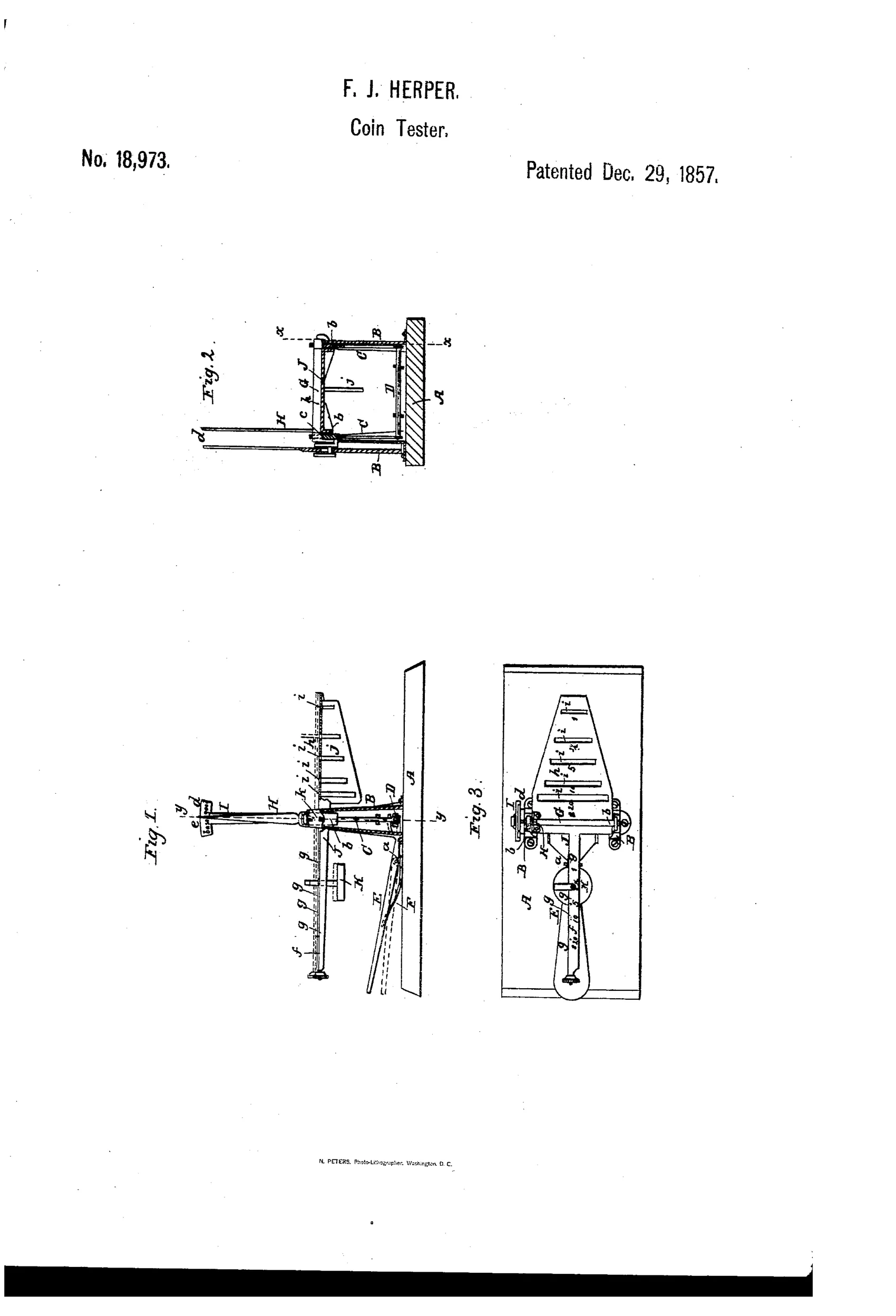
A balance scale for testing gold coins.
◉ How it works
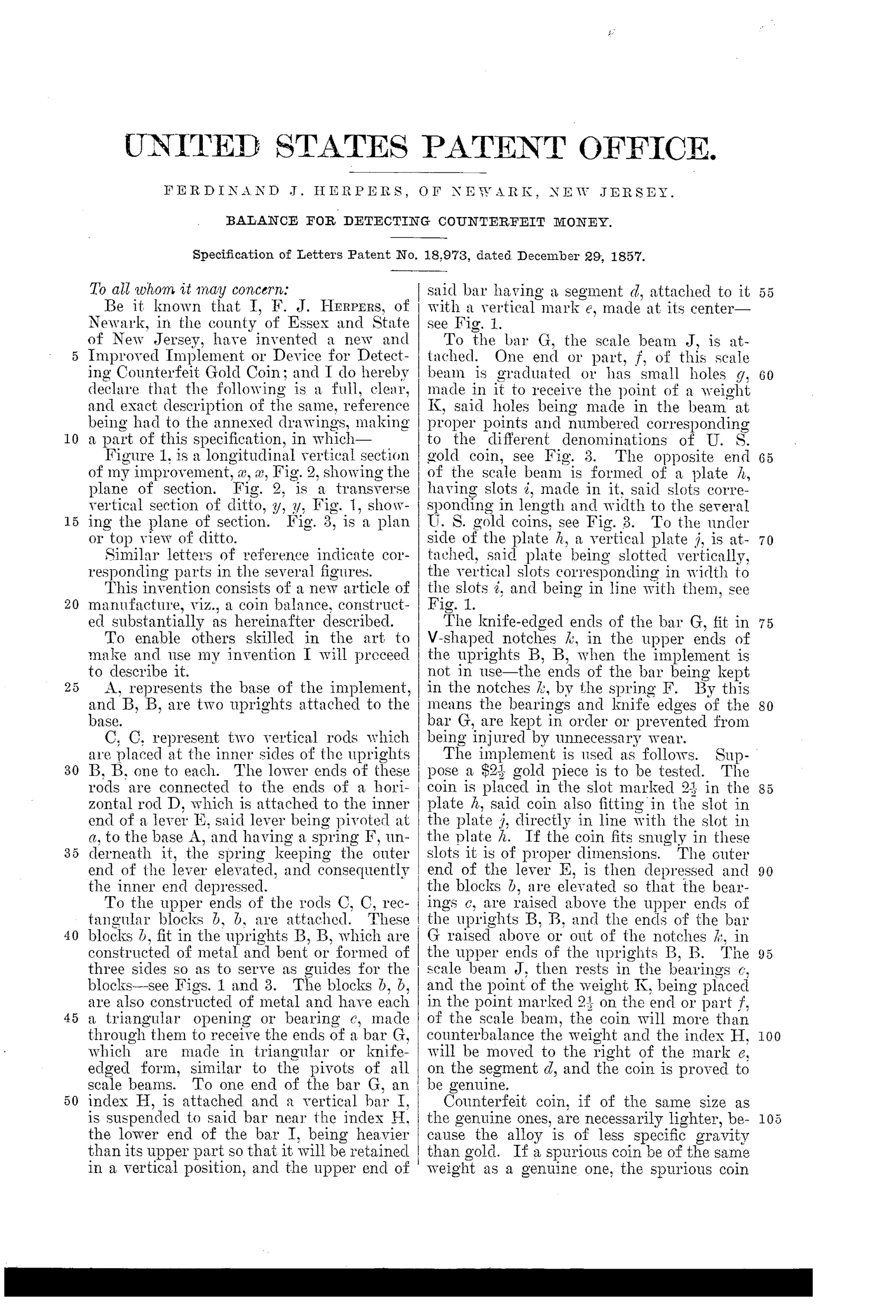
A coin is placed in a slot sized to a specific U.S. gold denomination, fitting both a slotted plate and a matching vertical slotted plate beneath it to check its dimensions. Depressing a lever raises knife-edged bearings so a graduated scale beam, weighted with a sliding counterweight, can pivot freely on the coin's other side. If the coin is genuine and of correct weight, it more than counterbalances the weight and swings an index past a center mark on a graduated segment; if underweight due to base metal (lower specific gravity than gold), the index fails to move past the mark, revealing the coin as spurious. When not in use, a spring holds the beam's knife edges seated in fixed notches, protecting the delicate bearings from wear.
◉ What was claimed
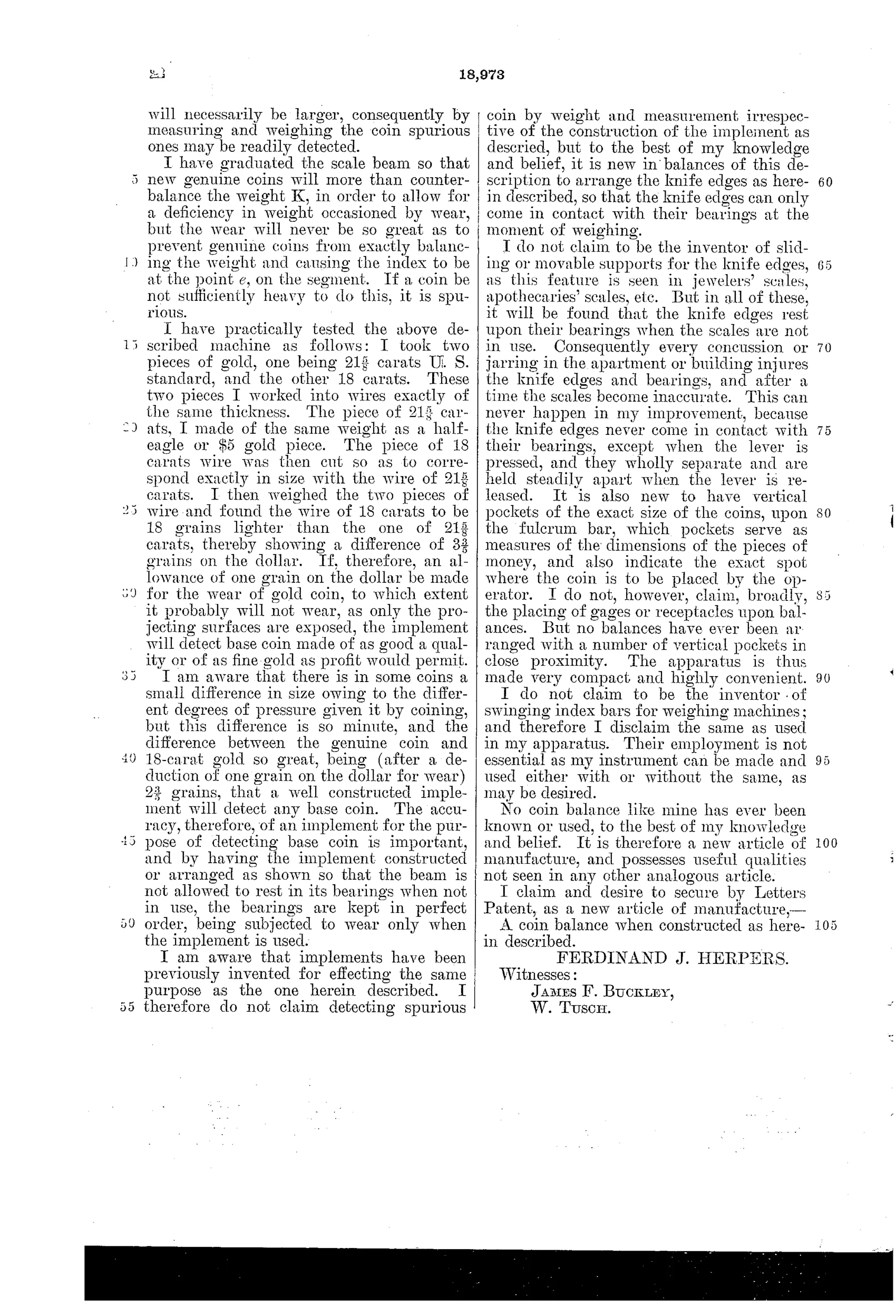
“I claim and desire to secure by Letters Patent, as a new article of manufacture,-- A coin balance when constructed as herein described.”
In plain English: The inventor claims the entire coin-testing balance scale as he described and built it.
◉ In the inventor’s words
“I have practically tested the above described machine as follows: I took two pieces of gold, one being 21 5/8 carats U. S. standard, and the other 18 carats.”— Ferdinand J. Herpers, from the specification
Fate unknown
Herpers was a working Newark craftsman and clearly built at least a prototype, but no marked surviving example is documented; one turning up in a collection would settle it.
◉ Commentary
Herpers filed this just two years after Allender's famous 1855 gauge set the pattern for American coin detectors, and it plays the same game with more precision-instrument seriousness. The core test is identical in spirit: a slot sized to a specific gold denomination checks diameter and thickness, and a counterweighted beam checks weight. Since no cheap base metal matches gold's density, a coin that fills the slot but fails to tip the beam is a fake. What Herpers adds is jeweler's craft — real knife-edge bearings on the beam, a graduated segment with an index pointer instead of a crude pass/fail rock, and a sliding counterweight for calibration.
The drawing rewards a second look at the lever mechanism in Fig. 1. The knife edges don't ride free all the time: a spring keeps them seated in fixed notches when idle, and depressing a lever lifts the beam onto its edges only during a test. That's the same discipline you find in assay balances, where the arrestment protects the pivots from every casual knock. It shows Herpers thinking about a counter-top instrument that would stay accurate through thousands of tests, not a novelty.
The honest question is whether the market wanted that refinement. Allender's simpler rocker was cheap, pocketable, and good enough; Herpers' machine is a small scientific instrument. His claim — the whole balance 'as a new article of manufacture' — suggests he meant to sell it, and his test with 21 5/8 and 18 carat gold pieces reads like a man who had one on the bench. Whether it ever left the bench is another matter.
Commentary by Claude, The Counterfeit Coin Detector Patent Archive’s resident enthusiast