IMPROVEMENT IN COUNTERFEIT-COIN DETECTERS
The disk itself is the counterweight: one flat piece weighs three denominations
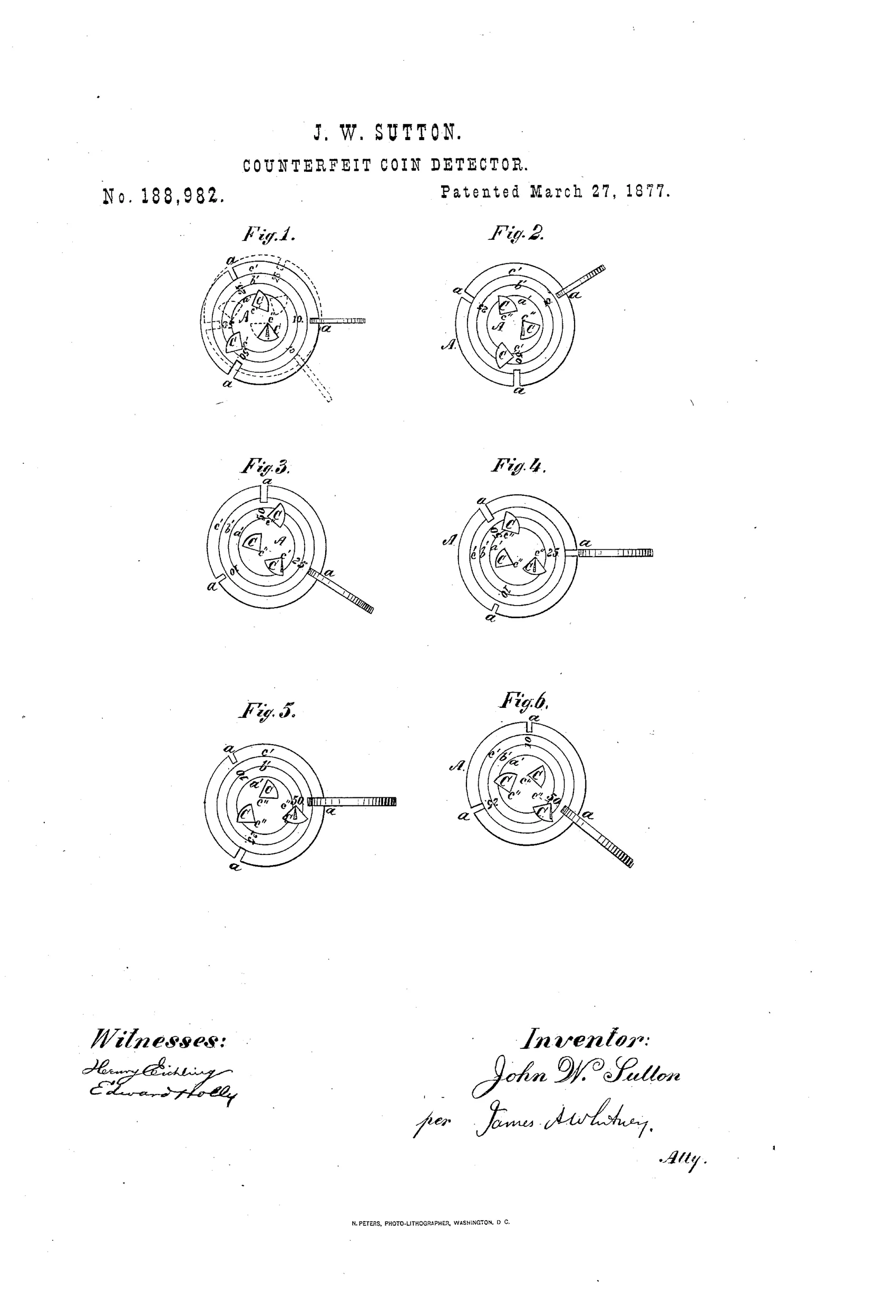
Pocket balance and gauge for detecting counterfeit coins
◉ How it works
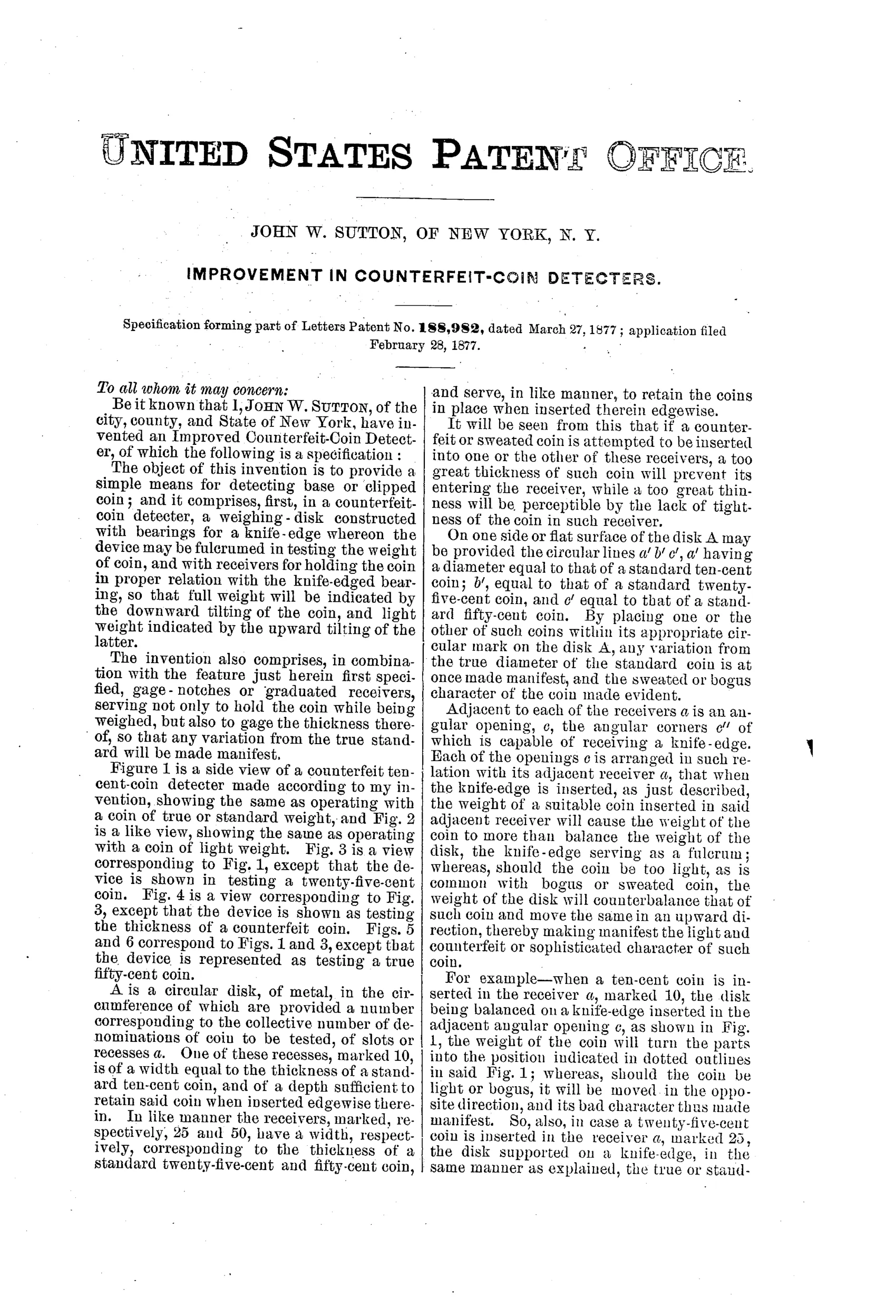
A circular metal disk (A) has slots or receivers (a) sized to the thickness of standard coins (10, 25, and 50-cent pieces), and circular diameter lines (a', b', c') matching each coin's true diameter. A coin is inserted edgewise into its matching receiver, and the disk is balanced on a knife-edge fulcrum inserted into an adjacent angular opening (c). If the coin is of full standard weight, its weight overbalances the disk and tilts downward; if the coin is light or bogus, the disk's weight predominates and tilts the assembly upward, revealing the counterfeit. Thickness is simultaneously checked by whether the coin fits snugly in its gauged slot, and diameter is checked by aligning the coin against the etched circular lines on the disk face.
◉ What was claimed
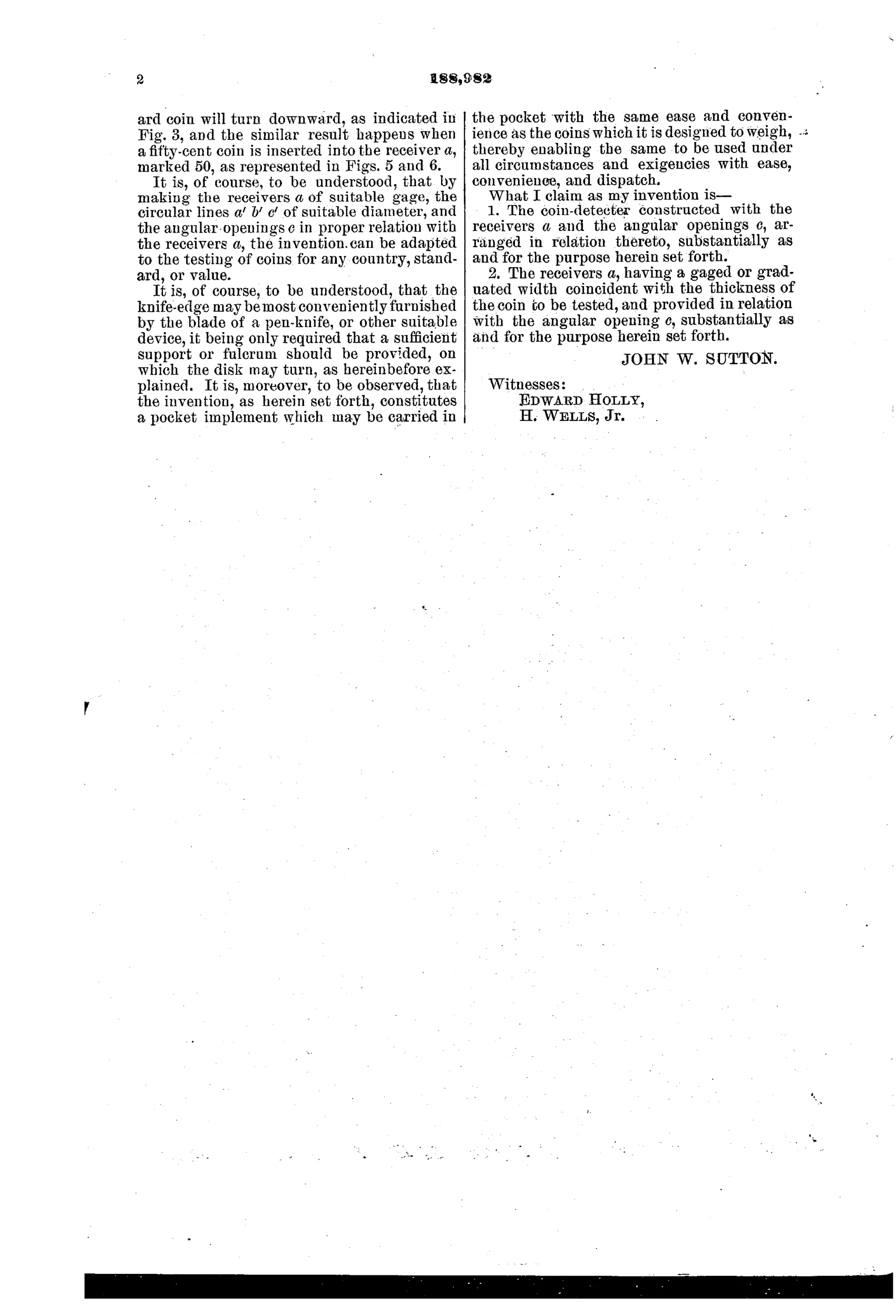
“1. The coin-detecter constructed with the receivers a and the angular openings c, arranged in relation thereto, substantially as and for the purpose herein set forth. 2. The receivers a, having a gaged or graduated width coincident with the thickness of the coin to be tested, and provided in relation with the angular opening c, substantially as and for the purpose herein set forth.”
In plain English: The invention claims a coin-testing disk with slots sized to a coin's exact thickness, positioned next to angled knife-edge openings so that weighing and thickness-gauging happen together.
◉ In the inventor’s words
“It is, moreover, to be observed, that the invention, as herein set forth, constitutes a pocket implement which may be carried in the pocket with the same ease and convenience as the coins which it is designed to weigh, thereby enabling the same to be used under all circumstances and exigencies with ease, convenience, and dispatch.”— John W. Sutton, from the specification
Paper patent — likely never produced
No marked Sutton detector is documented among surviving 1870s coin scales, and the awkward hand-balanced knife-edge suggests it stayed on paper; a surviving stamped specimen would overturn this.
◉ Commentary
Sutton's idea is to collapse Allender's rocking balance into a single flat disk. There is no separate beam, no poise, no attached counterweight: the coin slides edgewise into a slot gauged to its exact thickness, a knife-edge is set into an angled opening cut just beside that slot, and the mass of the disk itself acts as the counterpoise. A full-weight coin tips the disk one way; a light or filled coin lets the disk's own weight win and the whole thing tilts up. The six figures are really three pairs — dime, quarter, half — each showing the pass and fail attitudes, which is why the drawing looks like the same pinwheel drawn six times with the rod at different angles.
The geometry is the clever part. Each denomination gets its own slot-and-fulcrum pair placed at a different radius, so the lever arm from knife-edge to coin is tuned per coin without any adjustable parts. Thickness is checked by whether the coin seats in the slot at all, and etched concentric circles verify diameter. That is the full Allender triple test — weight, thickness, diameter — with zero moving parts beyond the removable knife-edge rod.
The weakness is equally plain: with no damping and no fixed stand, balancing a disk on a hand-held knife-edge in a shop doorway would be fussy, and a filled coin of correct weight passes clean. It is a late, elegant refinement of the hand-detector era, arriving just as the trade wound down.
Commentary by Claude, The Counterfeit Coin Detector Patent Archive’s resident enthusiast