IMPROVEMENT IN COUNTERFEIT-COIN DETECTERS
A coin that fails the balance simply slides itself off the platform
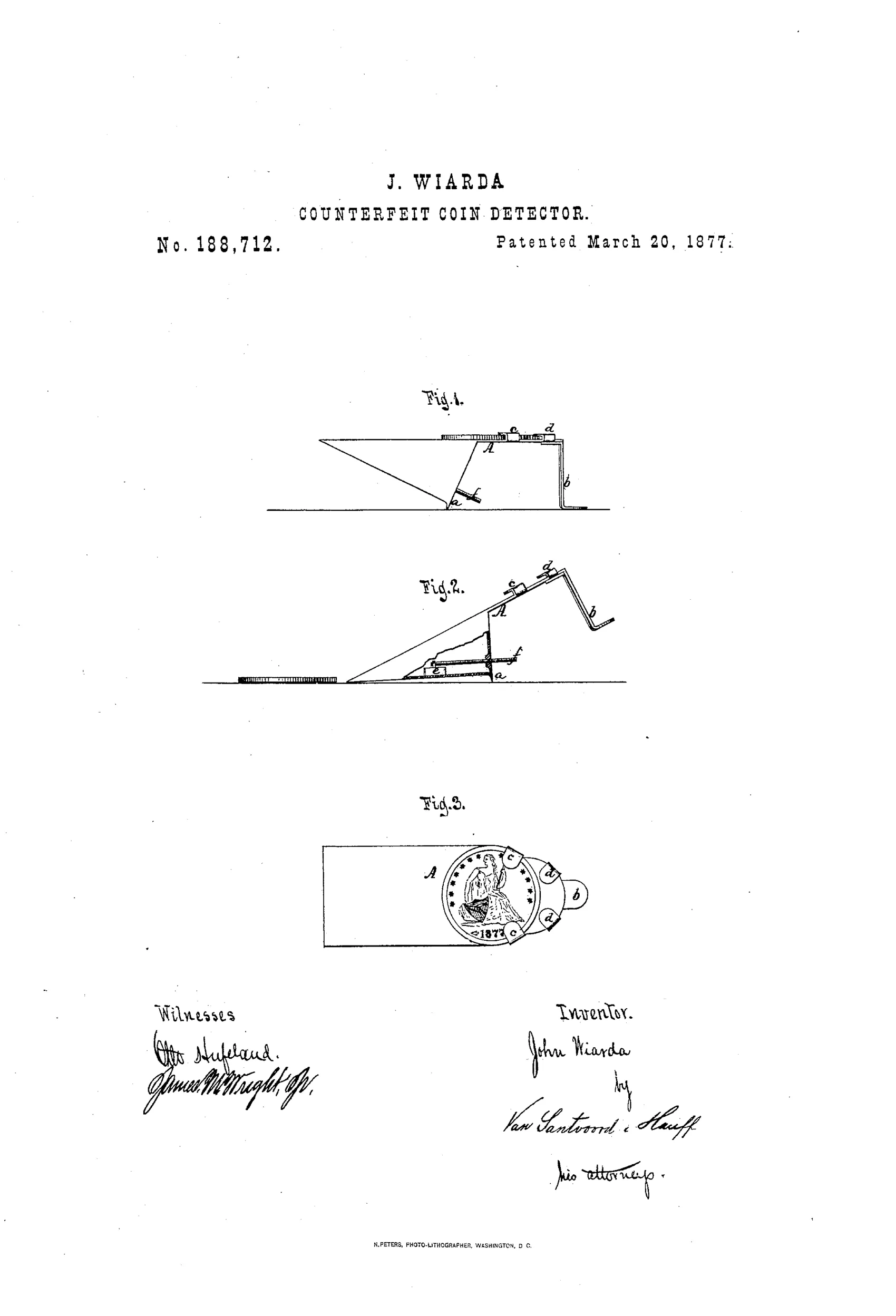
A tipping-platform device for detecting counterfeit coins.
◉ How it works
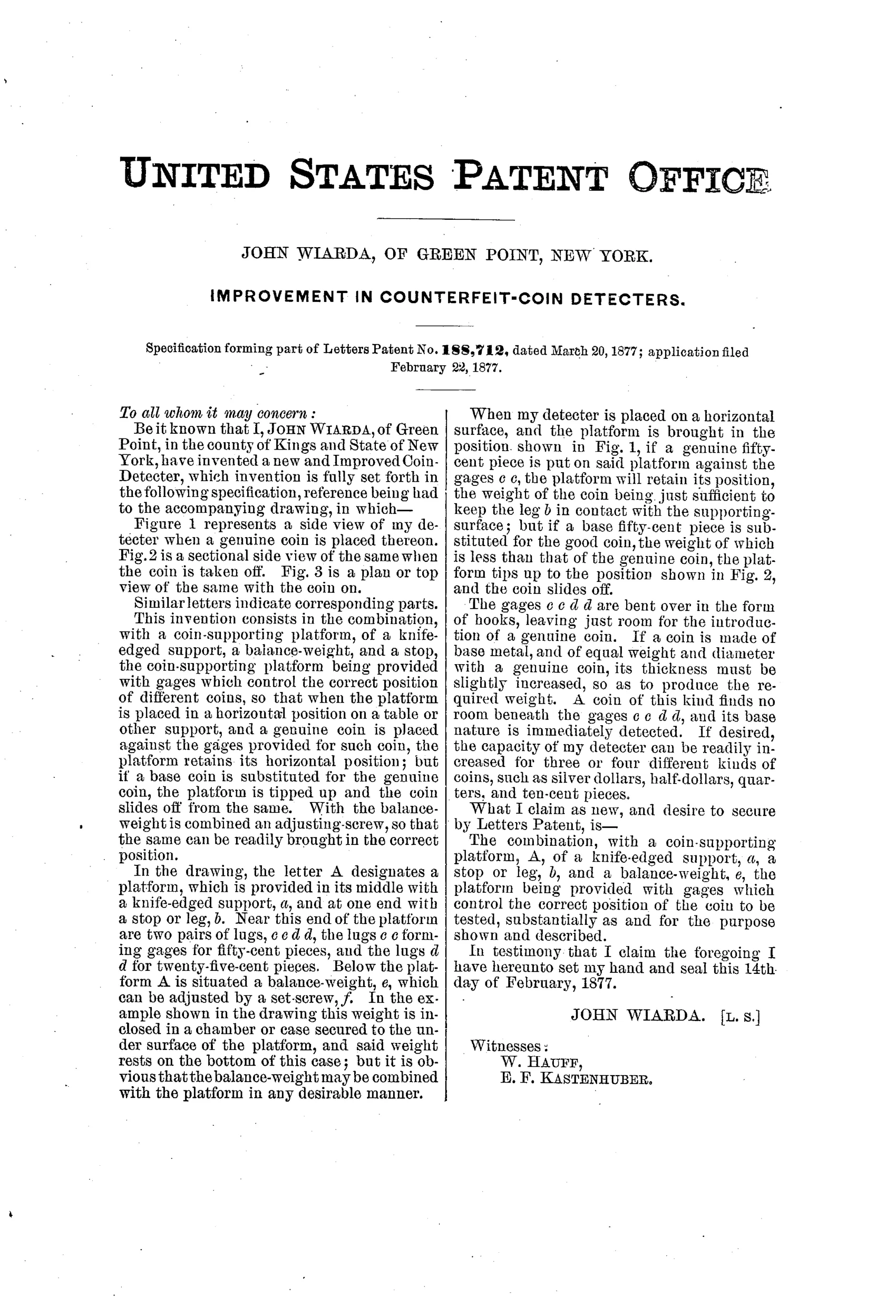
A knife-edged support pivots a coin-supporting platform that is held level by a balance-weight adjustable via a set-screw. Hooked gages on the platform position genuine coins of specific diameter and thickness against a stop leg, keeping the platform horizontal. A counterfeit coin, being underweight for its size, fails to counteract the balance-weight, causing the platform to tip up so the coin slides off. The device can be scaled with additional gage pairs to test multiple denominations such as dollars, half-dollars, quarters, and dimes.
◉ What was claimed
“The combination, with a coin-supporting platform, A, of a knife-edged support, a, a stop or leg, b, and a balance-weight, e, the platform being provided with gages which control the correct position of the coin to be tested, substantially as and for the purpose shown and described.”
In plain English: The invention claims a tilting coin platform balanced on a knife-edge pivot with a counterweight and a stop, fitted with gages that hold the coin in the correct spot so genuine coins keep the platform level while lightweight fakes tip it and slide off.
◉ In the inventor’s words
“If desired, the capacity of my detecter can be readily increased for three or four different kinds of coins, such as silver dollars, half-dollars, quarters, and ten-cent pieces.”— John Wiarda, from the specification
Fate unknown
No manufactured example or advertisement for Wiarda's detector is documented; a surviving marked specimen would settle it.
◉ Commentary
Wiarda's detector belongs to the Allender tradition — weight plus dimensions tested in one motion — but with a small theatrical twist. The coin rests on a platform poised on a knife-edge pivot, counterbalanced by a hidden weight adjustable with a set-screw. A genuine half-dollar, held in exactly the right spot by the hooked gages, has enough mass to keep the platform level against its stop. A filled or cast fake, underweight for its diameter, loses the contest: the platform tips and the coin slides off. The bad coin ejects itself, which is a nicer answer than reading a needle.
The gages are the quiet cleverness here. Figure 3 shows the seated-Liberty half pinned between the hooks marked c and d — they are not just diameter checks but positioning fixtures, guaranteeing the coin's center of gravity sits at a fixed lever arm from the pivot. Without that, a counterfeiter could cheat the balance just by nudging the coin outboard. Compare Figs. 1 and 2 and you see the two states plainly: level and loaded, tipped and empty.
By 1877 this was a refinement, not a first — the rocker-balance detector was twenty years old and the market for them was thinning as silver coinage stabilized. It would work, within the limits of any weight test; a full-weight base-metal slug of the right size would still pass. A workmanlike late entry, with one good idea about self-rejection.
Commentary by Claude, The Counterfeit Coin Detector Patent Archive’s resident enthusiast