COIN-SELECTING DEVICE
Sorting coins by the quality of their bounce off an adjustable anvil
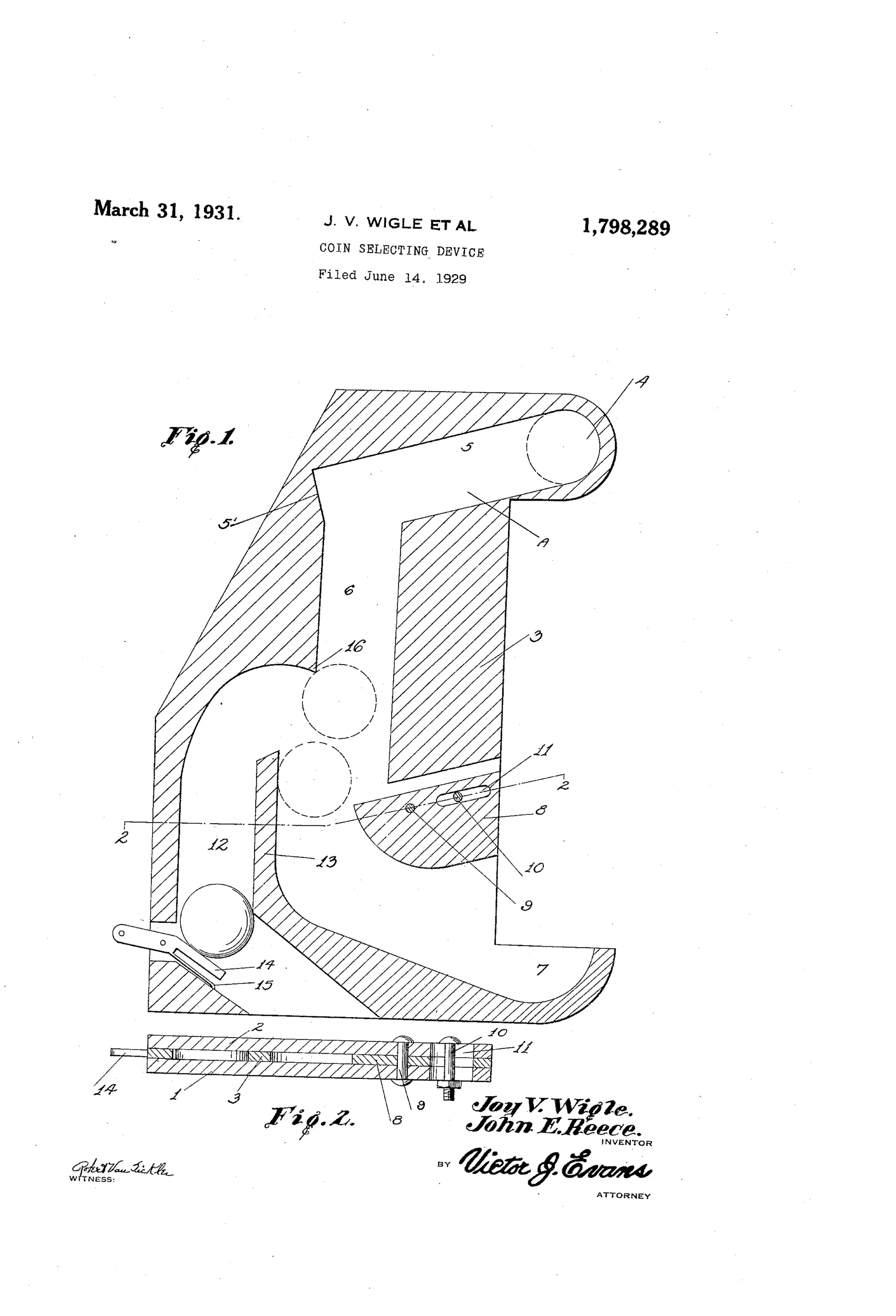
A coin-selecting device for coin-operated machines
◉ How it works
A coin dropped into the entrance opening rolls down an inclined slot into a main vertical slot where it strikes an adjustable anvil. If the coin is genuine, the bounce off the anvil carries it into a branch slot where it trips a spring-loaded latch that releases the machine mechanism. If the coin is a slug or wrong denomination, the bounce is either too great, causing it to strike an abutment ridge and drop into the reject tray, or too small, causing it to fall back below a partition wall into the same tray. The rear wall of the entrance slot is slightly inclined so that coins thrown in with force rebound and roll down at normal speed, preventing evasion of the anvil test.
◉ What was claimed
“A device of the character set forth including spaced side members detachably connected, an intermediate member secured between the side members and having entrance, main and branch slots closed at the sides thereof by the side members to form coin passages having communication, said entrance slot inclining downwardly from one edge of the intermediate member and communicating with the upper end of the main slot to direct coins therein and having the rear wall inclined upwardly and rearwardly to retard the coins and prevent them from entering the main slot with too great a force, said branch slot extending parallel with the main slot and having the upper portion thereof curved and communicating with the main slot intermediate the ends thereof and forming an abutment overlying the lower portion of the main slot, and an adjustable anvil extending into the main slot below the entrance of the branch slot and the abutment to cause proper coins passing downwardly in the main slot to bounce into the branch slot and improper coins to strike the abutment and be directed downwardly past the anvil into the lower portion of the main slot.”
In plain English: The device has an entrance slot leading into a main slot with an adjustable anvil; genuine coins bounce off the anvil into a branch slot that trips a release latch, while counterfeit or wrong-size coins either overshoot into an abutment or fall short, sending them past the anvil into a reject tray.
◉ In the inventor’s words
“The rear wall of the part 5 is slightly inclined, as shown at 5', so that if a coin is flipped or thrown into the slot with considerable force, the coin will strike this wall and rebound back into the part 5 and then roll down the same with the same speed that a coin would that was simply placed in the opening 4.”— Joy V. Wigle and John E. Reece, from the specification
Fate unknown
No assignee and no documented commercial mechanism traces to this patent; a marked vending mechanism or licensing record would settle it.
◉ Commentary
Most slug rejectors of the 1920s test what a coin is — its diameter, its weight, whether a magnet grabs it. Wigle and Reece's device tests what a coin does. A coin rolls down the entrance slot, drops in the main channel, and strikes an adjustable anvil. A genuine coin has a particular elasticity — that crisp ring of coin silver or a good bronze alloy — and rebounds just far enough to arc into the branch slot, where it trips the latch that releases the machine. A dead lead slug barely bounces and falls back into the reject tray; something too lively overshoots, hits the abutment ridge, and drops into the same tray. Too much bounce fails just as surely as too little.
The detail worth lingering on is the inclined rear wall at 5' in Fig. 1. The inventors anticipated the obvious cheat: hurl the coin in hard so momentum carries a slug past the test. The angled wall catches a thrown coin and sends it back to roll down at rolling speed, so every coin arrives at the anvil with the same velocity. That normalization is the whole game — a bounce test is meaningless unless the input is standardized.
Rebound testing did become a real technique in later coin acceptors, so this sits in the mainstream of the chute-tester era rather than at a dead end. Whether this particular Chattanooga version got built, or was simply one voice in a very loud chorus, the record doesn't say.
Commentary by Claude, The Counterfeit Coin Detector Patent Archive’s resident enthusiast