COIN-ASSORTING MECHANISM FOR FARE BOXES
The coin itself is the clutch: Murray's jam-proof fare box sorter
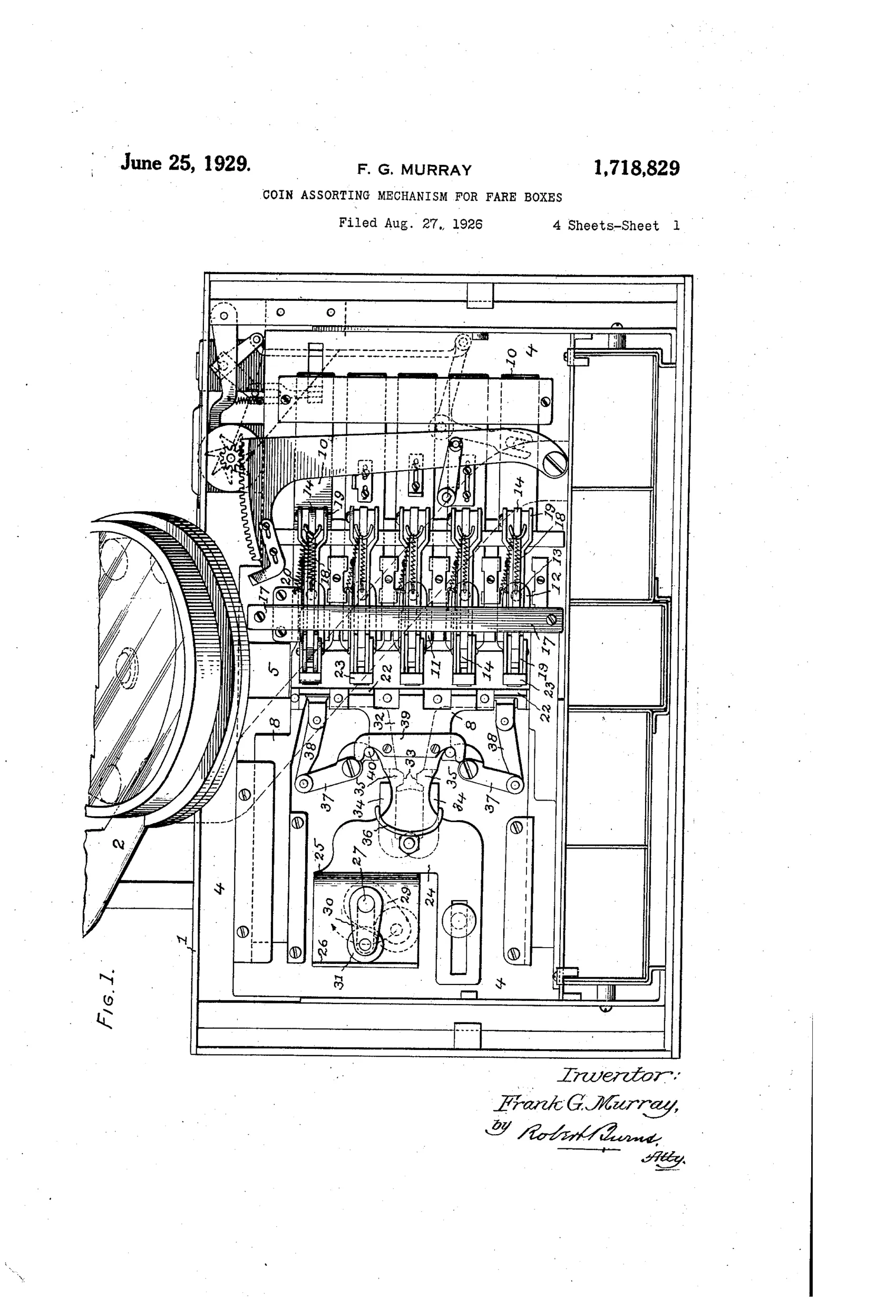
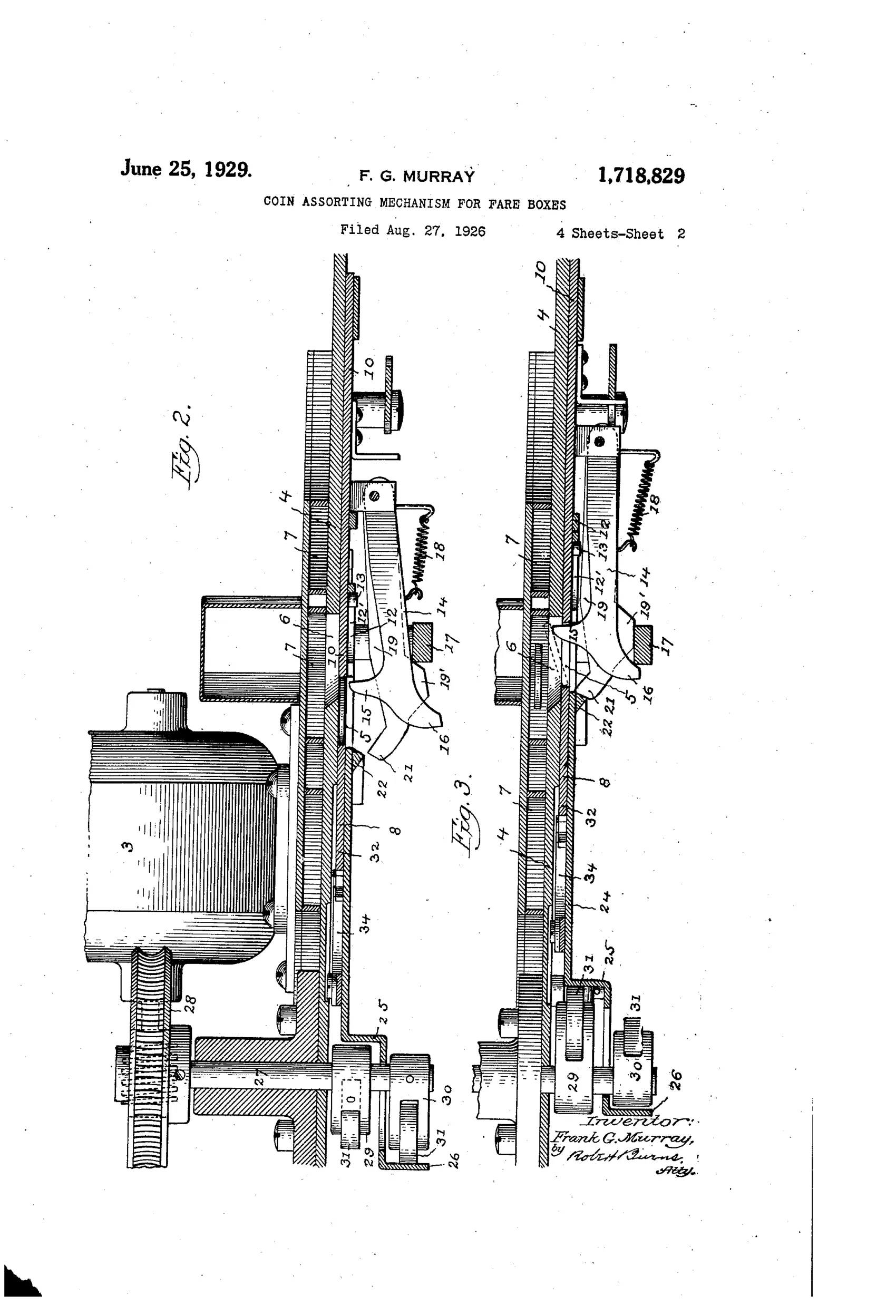
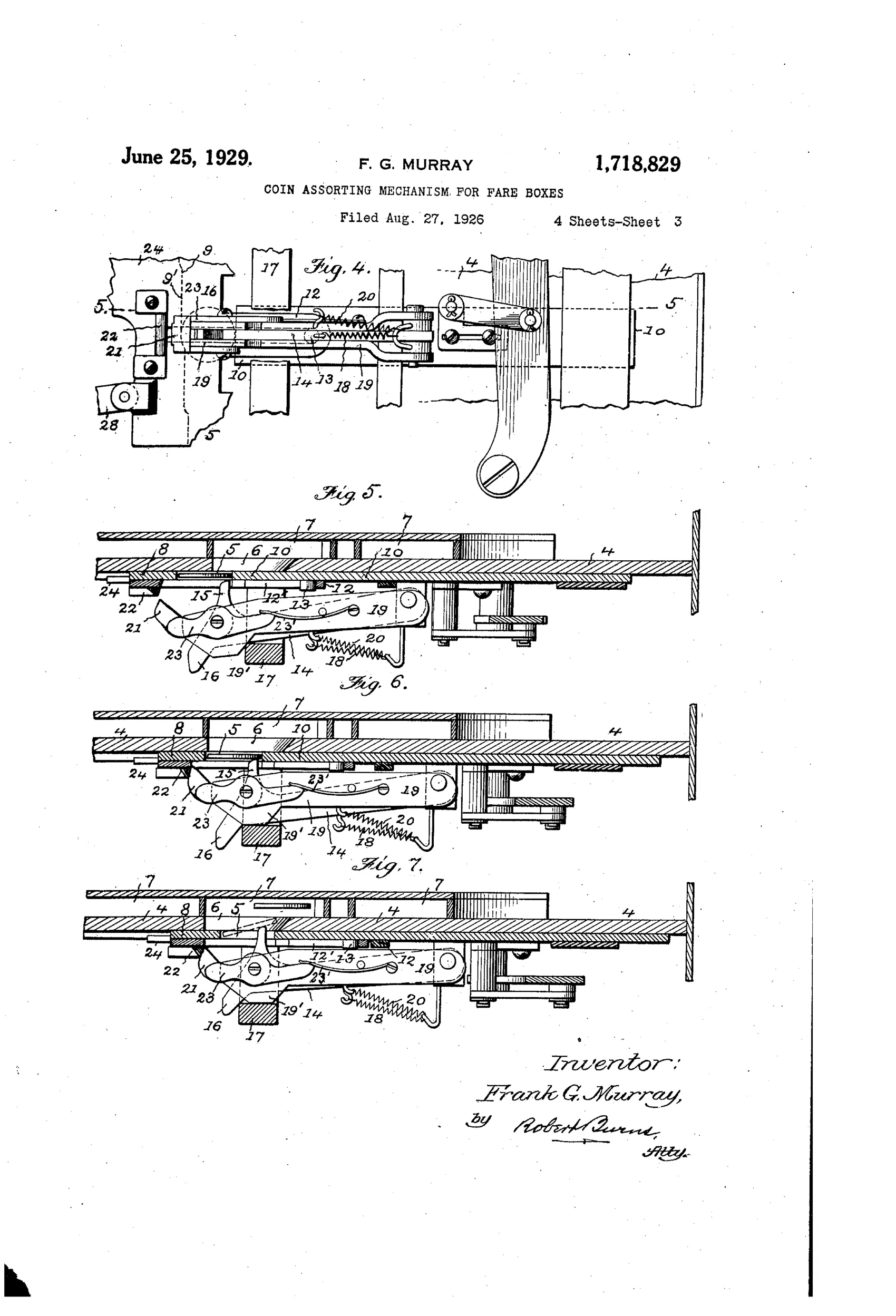
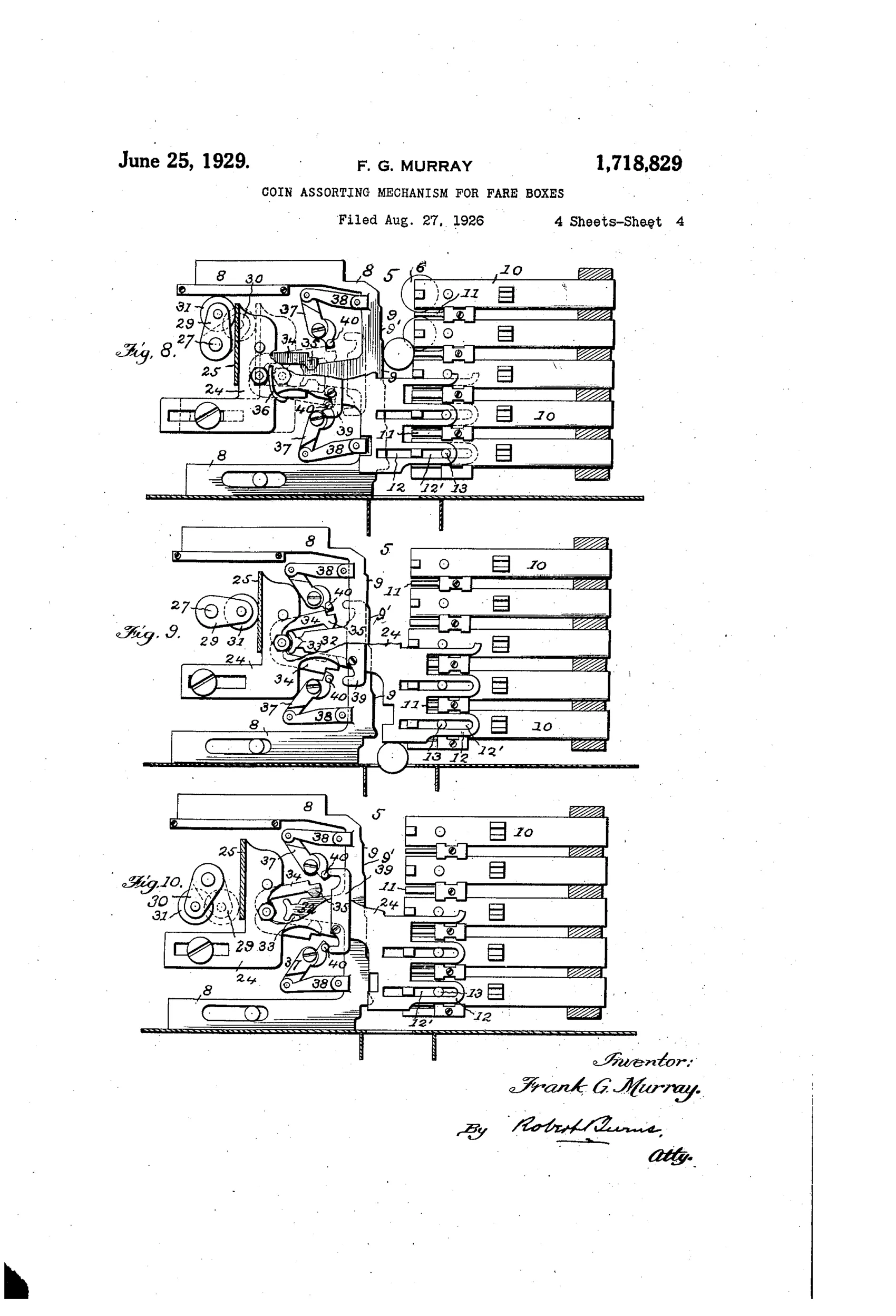
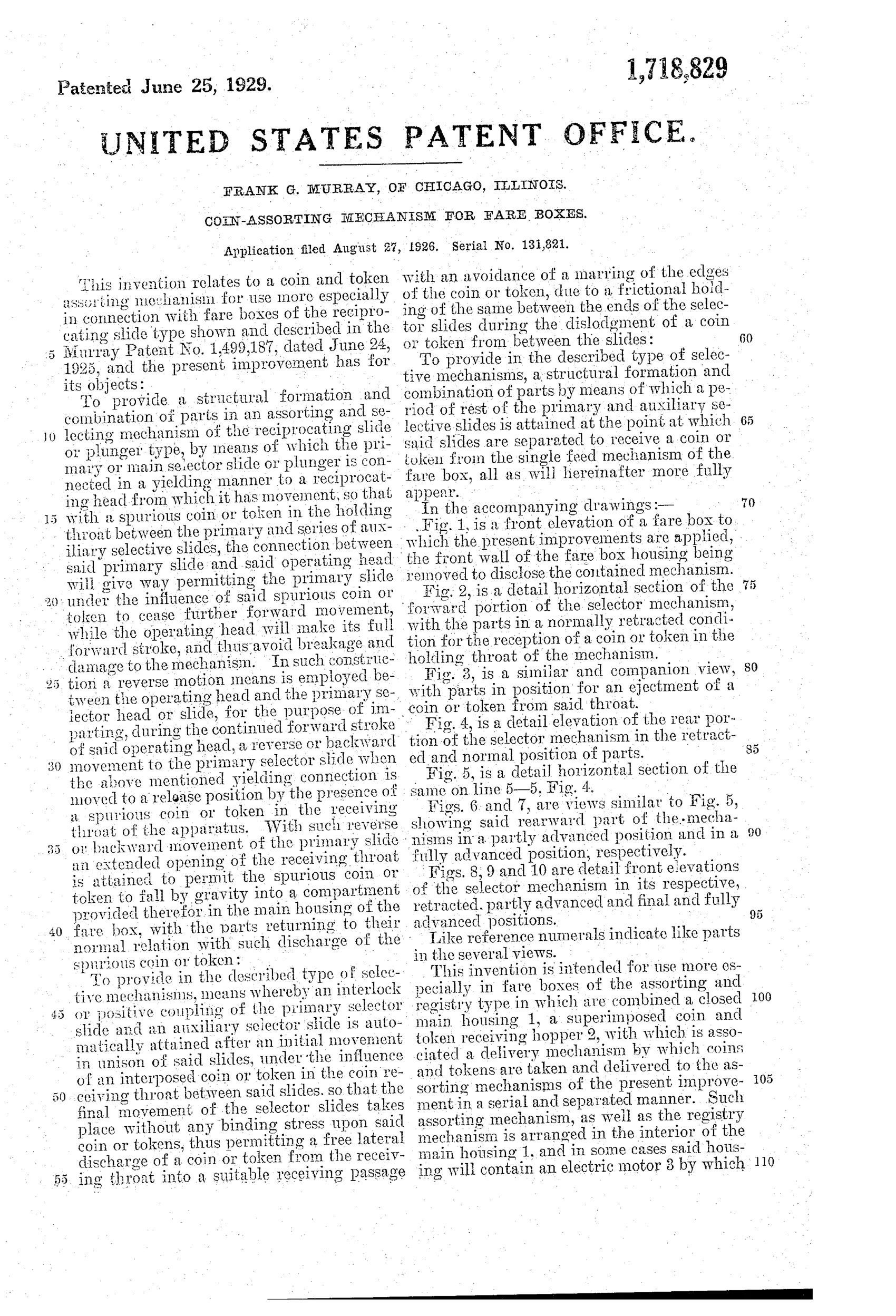
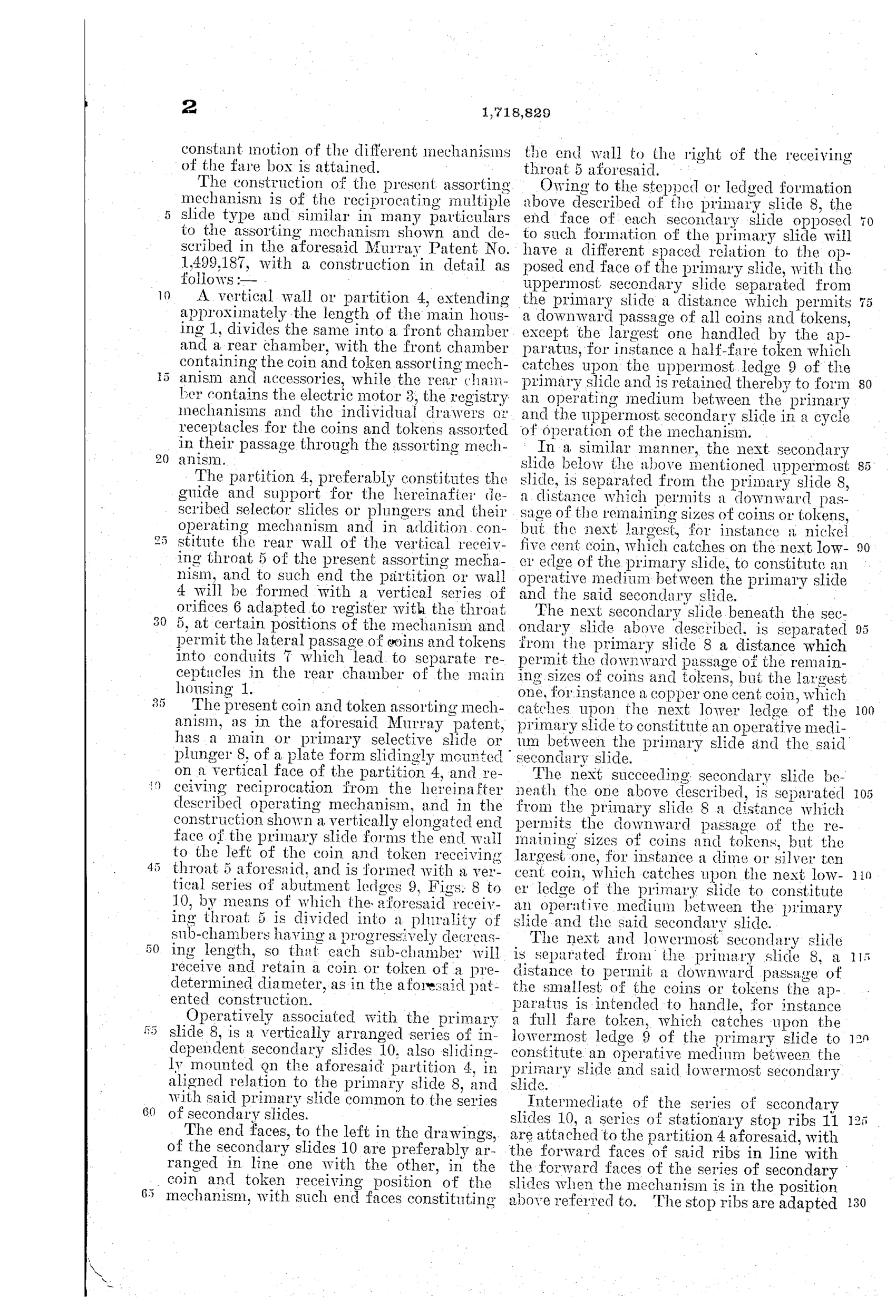
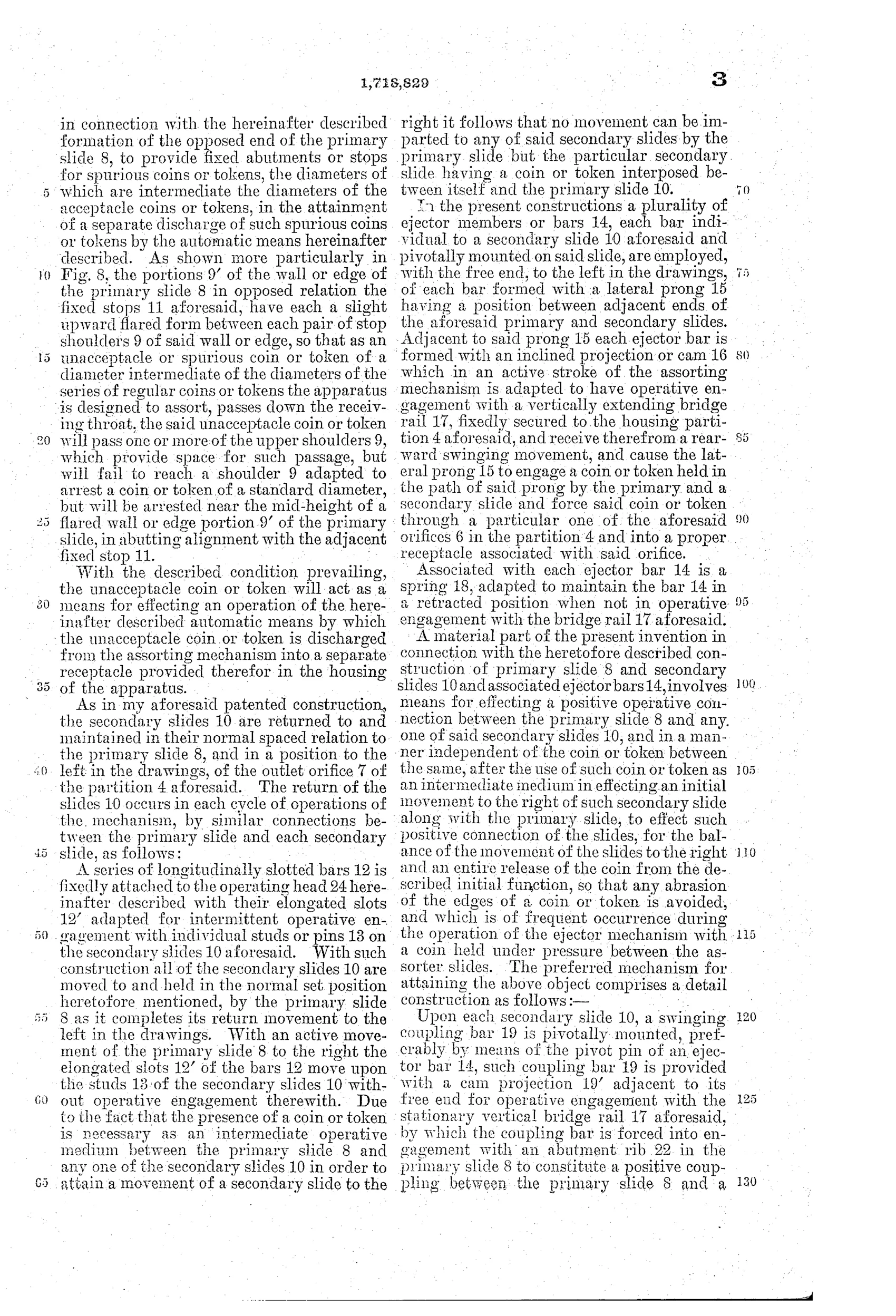
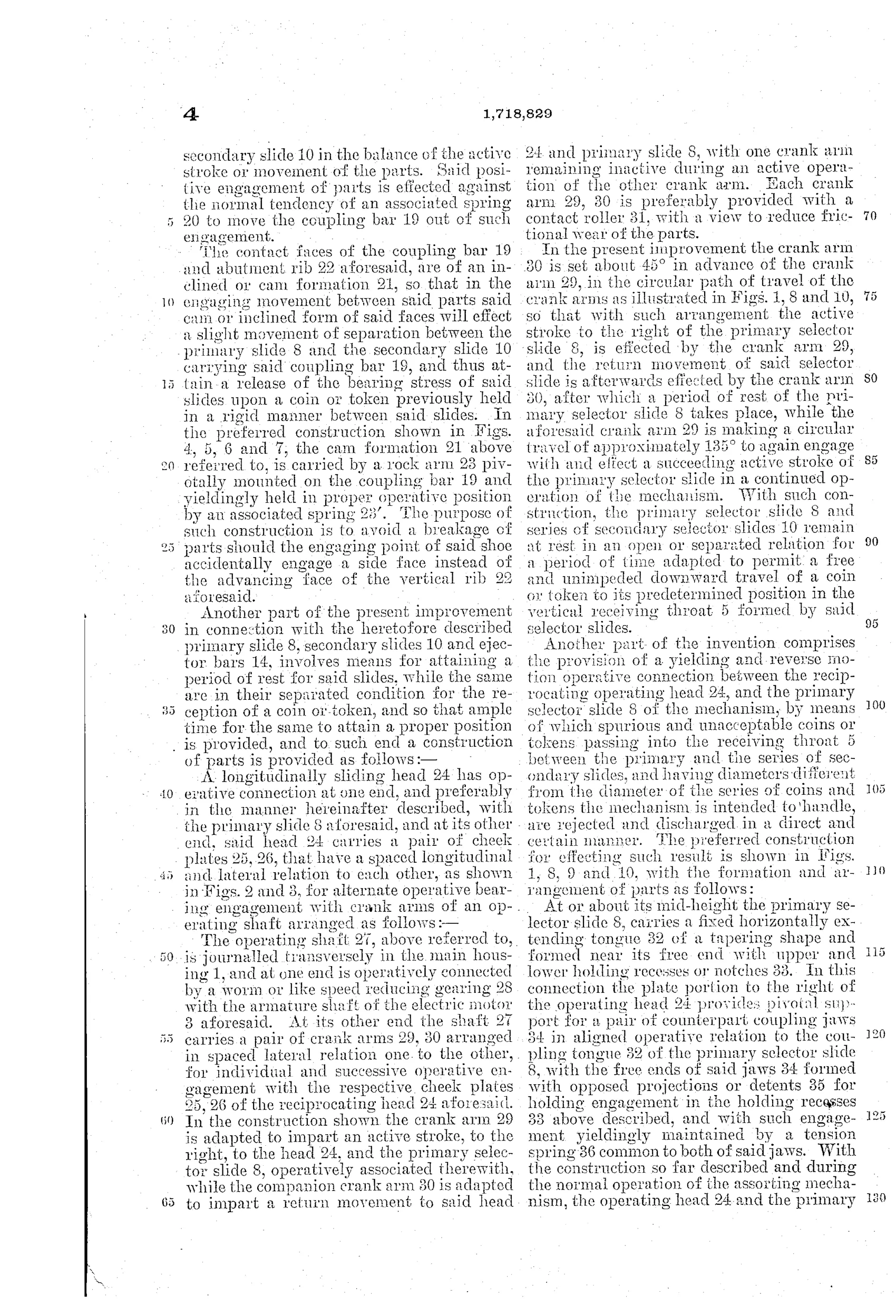
Coin-and-token sorting mechanism for transit fare boxes.
◉ How it works
A primary selector slide works against a vertical series of secondary slides mounted on a partition wall, each pair separated by a distance calibrated to a specific coin diameter, forming a stepped sizing throat that gauges and separates coins by size as they fall. A coin or token caught between the primary and a given secondary slide acts as an intermediate operative medium, coupling the two slides together via a swinging coupling bar and cam-faced abutment rib so the pair advances together while other slides stay idle. An ejector bar pivoted on each secondary slide carries a lateral prong that, cammed against a fixed bridge rail during the active stroke, sweeps the retained coin sideways through a matching orifice in the partition into its own coin chute and receptacle. A yielding, reverse-motion connection between the reciprocating operating head and the primary slide lets the primary slide stop short when a spurious or off-size coin is present, so the throat opens wider and gravity drops the rejected piece into a separate discharge compartment while the operating head still completes its full stroke without breaking the mechanism.
◉ What was claimed
“...a primary selector slide, a series of secondary selector slides in aligned relation to said primary slide and forming therewith a receiving throat for a coin or token, an operating head having a yielding connection with said primary slide whereby, upon the presence of a spurious coin or token in said throat, the primary slide is arrested while the operating head continues its stroke, and means whereby such arrest effects an opening movement of the primary slide relative to the secondary slides for discharge of the spurious coin or token.”
In plain English: The device has a main sliding gauge plate and a stack of secondary gauge plates that together form a coin-sizing slot, connected to the drive mechanism through a give-way linkage so that if an oversized or wrong coin gets stuck, the main plate stops and backs off to let the bad coin fall out separately, even though the drive arm keeps moving through its full stroke.
◉ In the inventor’s words
“In such construction a reverse motion means is employed between the operating head and the primary selector head or slide, for the purpose of imparting, during the continued forward stroke of said operating head, a reverse or backward movement to the primary selector slide when the above mentioned yielding connection is moved to a release position by the presence of a spurious coin or token in the receiving throat of the apparatus.”— Frank G. Murray, from the specification
Fate unknown
Chicago fare box makers absorbed many such mechanisms anonymously; a production fare box traceable to this patent number would settle whether Murray's design was built.
◉ Commentary
The neat trick here is buried in the coupling. Murray's fare box has one primary selector slide facing a vertical stack of secondary slides, each pair spaced to a different coin diameter, forming a stepped sizing throat. When a coin drops in and lodges at its proper step, the coin itself becomes the drive link — it couples the primary slide to that one secondary slide so the pair advances together while the rest of the stack sits idle. The coin is not merely gauged; it is conscripted as a machine part for the duration of the stroke.
The second idea is the one every coin-machine designer eventually needs: what happens when something wrong gets wedged in? Murray's answer is a yielding, reverse-motion connection between the crank-driven operating head and the primary slide. If a spurious or off-size piece blocks the throat, the primary slide stops — and then actually backs away — while the operating head sails through its full stroke unharmed. The bad coin drops by gravity into a reject compartment. The conductor keeps cranking; nothing bends.
By 1926 this class had long since moved past hand-held detectors into anonymous machinery, and Chicago was the center of the fare box trade. Fig. 1's dense elevation, with the hopper wheel at lower left and the tiered ejector prongs sweeping coins sideways through the partition, is a fine specimen of that industrial phase: not romantic, but genuinely thought through where it counts — the failure mode.
Commentary by Claude, The Counterfeit Coin Detector Patent Archive’s resident enthusiast