COIN-RECEIVING MECHANISM FOR VENDING MACHINES
Three failure modes, three separate exits: a coin tube that sorts its rejects
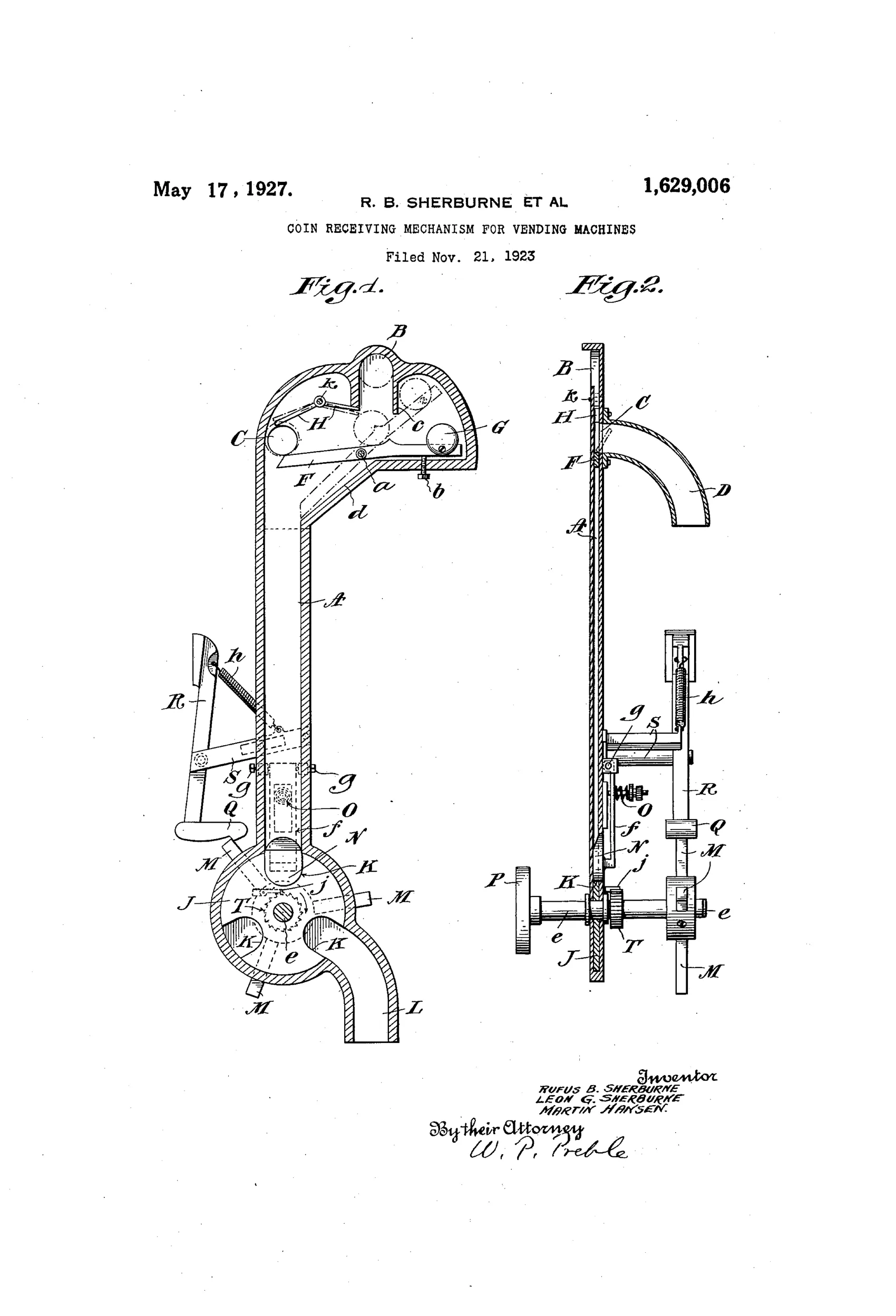
Coin testing and vending-machine release mechanism
◉ How it works
A coin dropped into the mouth of a receiving tube lands upright on a pivoted, counterbalanced testing lever which measures its weight. If the coin is heavy and sized correctly it tips the lever against an incline, sliding down a chute into a locking-disc pocket, while a hinged closure fork simultaneously seals the mouth against further coins. Undersized or underweight coins are ejected sideways through a size-testing aperture into a rejection spout, and correctly-sized-but-wrong-weight coins jam the closure fork, blocking the tube until removed. The accepted coin unlocks a normally locked, spring-loaded releasing disc with pockets, which a purchaser rotates via a handle to trip a detent lever and release merchandise through a discharge tube, after which a ratchet and pawl prevent the disc from being turned back to steal a second item.
◉ What was claimed
“A coin receiving mechanism for vending machines which comprises a coin receiving tube provided with a weight-testing lever, a size-testing aperture co-operating with said lever to drop out undersized coins and a tilting lever adapted to close the entrance to said tube under pressure from over-sized coins,\u2014and a normally locked releasing device adapted to be unlocked by coins delivered to it by said receiving tube, after passing said testing levers and aperture.”
In plain English: The coin tube uses a weight-testing lever and a sizing hole to reject undersized coins, a tilting lever to block oversized coins, and only a properly sized and weighted coin unlocks the merchandise-release mechanism.
◉ In the inventor’s words
“Under this reorganized system a single competent person can keep a large number of vending machines supplied with the selected articles or parcels of merchandise and thus take the place of several salesmen.”— Rufus B. Sherburne, Leon G. Sherburne, and Martin Hansen, from the specification
Fate unknown
Like most in-chute testers, this design left no marked trace; a surviving machine or Sherburne company records would settle whether it reached production.
◉ Commentary
Most chute testers of the 1920s were binary: the coin either passes or falls into a reject cup. The Sherburnes and Hansen designed something fussier and more interesting — a mechanism that distinguishes between kinds of bad coins and handles each differently. Undersized or light coins slip sideways through a sizing aperture into a rejection spout. Oversized coins jam a hinged closure fork and physically block the tube's mouth, forcing an attendant visit. Only a coin that is right in both diameter and weight tips the counterbalanced lever and slides into the release disc. That's a diagnostic tester as much as a gatekeeper.
Look closely at Fig. 1 and you can see the whole logic in one vertical section: the coin lands upright on the pivoted lever near the top, and the paths diverge from there. The lower half is the payoff — a pocketed disc the customer rotates by handle, with a ratchet and pawl to stop anyone winding it backward for a free second item. The inventors were clearly thinking about theft from both ends: slugs going in, merchandise coming out.
The patent's stated ambition — letting one route man service many machines in place of several salesmen — places it squarely in the automat-era boom, when vending was pitched as labor arbitrage. Mechanically it should work, though the jamming-fork feature trades vandal resistance for service calls. A workmanlike, thoughtful entry in a crowded decade.
Commentary by Claude, The Counterfeit Coin Detector Patent Archive’s resident enthusiast