BALANCE FOR DETECTING SPURIOUS COIN.
The original Allender gauge: one lever proves five gold coins by size and weight
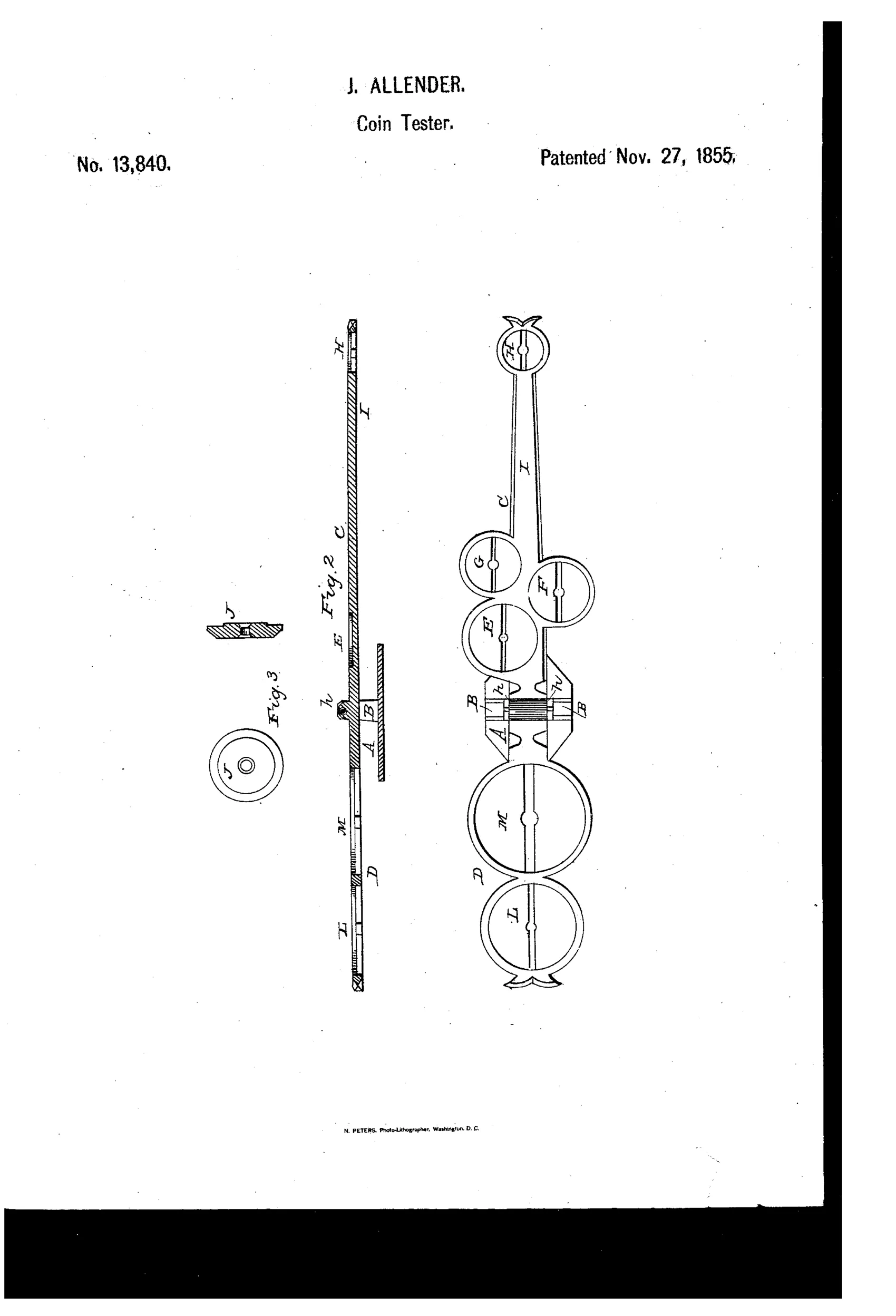
Lever balance for testing genuine gold coins.
◉ How it works
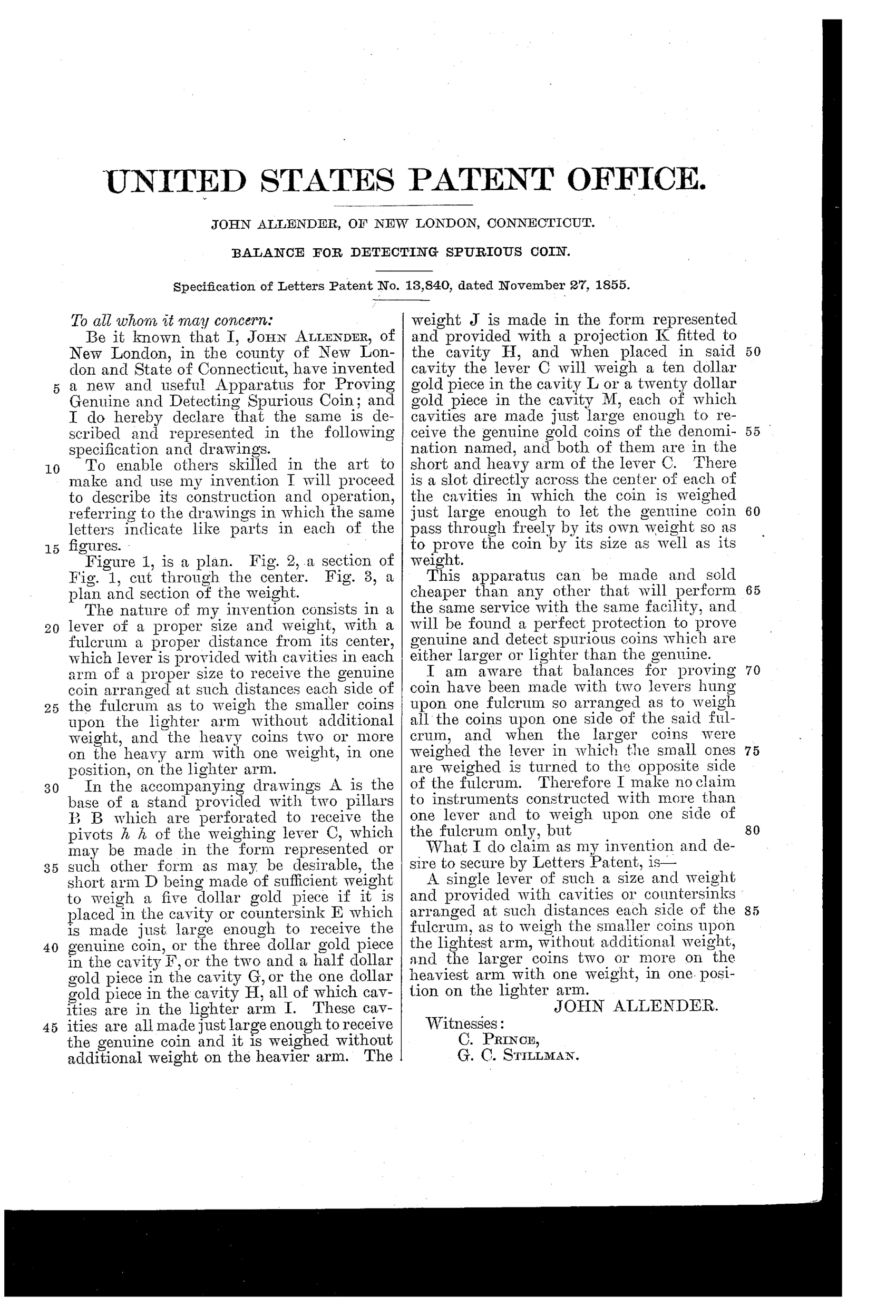
A single weighing lever pivots on a fulcrum mounted between two pillars on a base stand. The lever has cavities or countersinks of precise size arranged at differing distances from the fulcrum, each sized to fit a specific genuine gold coin denomination. Smaller coins are weighed on the lighter, longer arm without any additional weight, while larger coins are weighed on the shorter, heavier arm using one added weight in a single position. A slot across the center of each cavity lets a coin of proper size pass through by its own weight, so the coin is proven correct by both size and weight simultaneously.
◉ What was claimed
“A single lever of such a size and weight and provided with cavities or countersinks arranged at such distances each side of the fulcrum, as to weigh the smaller coins upon the lightest arm, without additional weight, and the larger coins two or more on the heaviest arm with one weight, in one position on the lighter arm.”
In plain English: The invention is a single lever balance with coin-sized cavities placed at set distances from the fulcrum, so small coins balance on the light arm unaided, while larger coins balance on the heavy arm using just one movable weight.
◉ In the inventor’s words
“This apparatus can be made and sold cheaper than any other that will perform the same service with the same facility, and will be found a perfect protection to prove genuine and detect spurious coins which are either larger or lighter than the genuine.”— John Allender, from the specification
Manufactured and sold
Allender's coin detectors were commercially produced in the 1850s and marked specimens survive in numbers; they are the best-known artifacts of this category.
◉ Commentary
This is the founding document of the category — the 1855 patent behind the brass rockers that collectors simply call "Allender detectors." The problem it attacks was real and daily: gold coins circulated at face value, and a filled or electrotype half eagle looked perfect but weighed wrong or measured wrong. Allender's insight was that one test isn't enough — a counterfeiter can match weight with a thick base-metal coin or match diameter with a thin one, but matching both at once with cheap metal is nearly impossible. So every cavity here is a slot gauge and a weighing pan simultaneously: the coin must drop through the sized opening AND balance the lever.
The drawing rewards a closer look. The cavities labeled E through M aren't spaced randomly — each denomination sits at a distance from the fulcrum calibrated so the lever's own mass does the counterweighing for the small coins, while the big coins on the short heavy arm need only the single sliding weight J at one fixed position. That's the whole claim: no loose weight set, no adjustment, nothing to lose except one piece. It's a scale reduced to its irreducible minimum, which is exactly what a shopkeeper needed at the counter.
Allender wasn't shy about it — 'cheaper than any other that will perform the same service' — and for once the boast held up. This design and its 1850s revisions were manufactured in quantity, imitated by Maranville and others, and set the template the whole pre-vending era followed.
Commentary by Claude, The Counterfeit Coin Detector Patent Archive’s resident enthusiast